Introduction to Robotics
Start with the robot system
Read the course overview to see how sensors, motion planning, actuators, and control fit into robotics.
Start with: Introduction to Robotics
RedLectern topic
AI that perceives and acts in physical environments · sensing · planning · control.
For: Learners · researchers
After this page you can: Explain the difference between digital actions and physical control.
Page reviewed
Part of: Artificial Intelligence
Embodied AI studies systems that perceive and act in environments through a physical body, such as a robot. Its central distinction from a purely digital response is that an intended action must connect to movement in the world. A robot may need to use camera or other sensor readings, choose a motion, and account for what happens when that motion meets an object or a changing scene.
A useful way to follow the field is to trace a loop: sensing provides information about the surroundings; planning selects what to do; control turns a plan into commands for a particular machine; new sensing helps the system respond to what actually happened. These parts can be combined in different ways. A vision-language-action model, for example, maps visual and language inputs to robot actions, while a separate low-level controller may handle safe movement. Studying embodied AI therefore means asking both what an AI system decides and how its decisions become physical actions.
Read the course overview to see how sensors, motion planning, actuators, and control fit into robotics.
Start with: Introduction to Robotics
Follow a robot through mapping an unknown place, estimating its location, and choosing a route.
Start with: Unit 4: Probability and Planning
Embodied AI connects computation to a system that can sense and act in a physical environment. That connection changes what counts as an action: a digital system can return a label or instruction, while a robot must turn a selected action into commands that affect a body and its surroundings. The body and environment matter because different machines have different movement capabilities, and physical interactions can change what the system senses next.
A useful distinction is between a high-level intention, such as moving an object, and the lower-level movements that carry it out. A model can contribute to choosing or representing an action, but physical control also depends on the robot and its controllers. When reading a robotics paper, identify the system’s inputs, its action outputs, and the physical platform on which those outputs are used.
An example of a model representing robot actions as outputs that can be used for control.
Embodied AI
AI that perceives and acts within a physical environment.
Vision-language-action model
A model that uses visual and language information to produce actions for controlling a robot.
A robot receives the instruction “place the cup on the shelf.” Name one digital output it might produce and one physical action the robot must carry out.
A digital output could be a plan or action label. The robot must move its arm and gripper to pick up the cup and place it on the shelf.
A robot plans from information about its surroundings, but that information can be incomplete or uncertain. MIT’s robotics teaching materials use mapping an unknown space, estimating a robot’s location in a known space, and plotting a route through a maze as linked planning problems. These examples help distinguish perception from planning: sensing supplies measurements, estimation uses them to infer a useful state, and planning selects a route or action toward a goal.
For an embodied system, a plan is tied to what the robot can sense and do. Ask what the sensors observe, what the system must infer, and which choices remain open when the observations are uncertain. A route selected from a map is still a plan; it does not itself guarantee the robot has moved safely through the physical space.
Use the overview to connect sensors and motion planning to robot mechanisms and control.
A mobile robot has a map but is unsure where it is. What must it estimate before it can use the map to plan a route?
It must estimate its location in the mapped space. With that estimate, it can select a route from its current position toward the goal.
Control connects a desired movement to commands that a robot’s actuators can carry out. The robot’s mechanics and dynamics shape that connection: a plan that looks sensible at an abstract level may need to be adjusted for the machine’s movement and interaction with its surroundings. Feedback adds another step. The system senses what happened, compares it with what was intended, and can adapt its actions when the scene changes or an object slips.
This distinction is useful when evaluating claims about a robot. Ask whether a result concerns interpreting an instruction, planning a movement, issuing motor commands, or completing the physical task. MIT’s robotics courses treat motion planning, control, actuators, and sensors as related but distinct topics. Keep the robot’s actual body and control setup in view when interpreting an action model’s output.
For a deeper look at nonlinear dynamics, motion planning, and control in mechanical systems.
An example of a system monitoring surroundings and adjusting actions when the situation changes.
A robot plans to grasp a block, but the block shifts before the gripper arrives. What should a feedback-based system do next?
Use new sensor information to update the estimate of the block’s position, then revise the movement or grasp plan before continuing.
No recent updates are available.
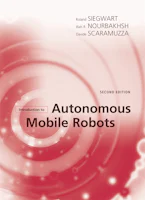
Roland Siegwart, Illah Reza Nourbakhsh, and Davide Scaramuzza · 2011
Connects a robot’s movement through the world with sensing, perception, localization, and motion planning. The second edition dates from 2011, so use it for these durable mobile-robot foundations.
Kevin M. Lynch and Frank C. Park · 2017
Develops system-level foundations for robot mechanics, motion planning, and control. The authors provide a free preprint of the 2017 book.
Nikolaus Correll · 2016
An open 2016 textbook that introduces robot motion, sensing, perception, localization, and mapping. Its coverage gives learners a grounded entry into how computation meets robot hardware and environments.
Sebastian Thrun, Wolfram Burgard, and Dieter Fox · 2005
Focuses on probabilistic perception and control under uncertainty, including estimation, mapping, and decision-making. Its 2005 edition teaches durable foundations, not newer embodied-AI systems.