The Diary of Samuel Pepys (part 4 of 4)
23rd. To church, and heard a good sermon of Mr. Gifford's at our church, upon "Seek ye first the kingdom of Heaven and its righteousness, and all things shall be added to you." A very excellent and persuasive, good and moral sermon. He showed, like a wise man, that righteousness is a surer moral way of being rich, than sin and villany. After dinner to the office, Mr. Gibson and I, to examine my letter to the Duke of York; which, to my great joy, I did very well by my paper tube, without pain to my eyes. And I do mightily like what I have therein done; and did according to the Duke of York's order make haste to St. James's, and about four o'clock got thither: and there the Duke of York was ready expecting me, and did hear it all over with extraordinary content; and did give me many and hearty thanks, and in words the most expressive tell me his sense of my good endeavours, and that he would have a care of me on all occasions; and did with much inwardness tell me what was doing, suitable almost to what Captain Cocke tells me, of designs to make alterations in the Navy: and is most open to me in them, and with utmost confidence desires my further advice on all occasions: and he resolves to have my letter transcribed and sent forthwith to the office. So with as much satisfaction as I could possibly or did hope for, and obligation on the Duke of York's side professed to me, I away.
25th. Up, and by water to St. James's; and there with Mr. Wren did discourse about my great letter, which the Duke of York hath given him; and he hath set it to be transcribed by Billings his man, whom, as be tells me, he can most confide in for secresy; and is much pleased with it, and earnest to have it be: and he and I are like to be much together in the considering how to reform the office, and that by the Duke of York's command. Thence I, mightily pleased with this success, away to the office; where all the morning, my head full of this business. And it is pretty how Lord Brouncker this day did tell me how he hears that a design is on foot to remove us out of the office; and proposes that we two do agree to draw up a form of new constitution of the office, there to provide remedies for the evils we are now under, that so we may be beforehand with the world; which I agreed to, saying nothing of my design: and the truth is, he is the best man of them all, and I would be glad next myself to save him; for as he deserves best, so I doubt he needs his place most.
26th. It is strange to see with what speed the people employed do pull down Paul's steeple, and with what ease: it is said that it and the quire are to be taken down this year, and another church begun in the room thereof the next. Home by coach with Sir D. Gauden; who by the way tells me how the City do go on in several things towards the building of the public places, which I am glad to hear; and gives hope that in a few years it will be a glorious place. But we met with several stops and troubles in the way in the streets, so as makes it bad to travel in the dark: now through the City. So I to Mr. Batelier's by appointment, where I find my wife and Deb. and Mercer; Mrs. Pierce and her husband, son, and daughter; and Knipp and Harris, and W. Batelier and his sister Mary and cosen Gumbleton, a good-humoured fat young gentleman, son to the Jeweller, that dances well. And here danced all night long, with a noble supper; and about two in the morning the table spread again for a noble breakfast beyond all moderation; and then broke up.
27th. To St. James's; and there with Mr. Wren did correct his copy of my letter, which the Duke of York hath signed in my very words, without alteration of a syllable. And so, pleased therewith, I to my Lord Brouncker, who I find within, but hath business, and so comes not to the office to-day. And so I by water to the office, where we sat all the morning: and just as the Board rises comes the Duke of York's letter; which I knowing, and the Board not being full, and desiring rather to have the Duke of York deliver it himself to us, I suppressed it for this day, my heart beginning to falsify in this business, as being doubtful of the trouble it may give me by provoking them; but, however, I am resolved to go through it, and it is too late to help it now. At noon to dinner to Captain Cocke's, where I met with Mr. Wren; my going being to tell him what I have done, which he likes, and to confer with Cocke about our office; who tells me that he is confident the design of removing our officers do hold, but that he is sure that I am safe enough. So away home; and there met at Sir Richard Ford's with the Duke of York's Commissioners about our prizes, with whom we shall have some trouble before we make an end with them.
28th. To White Hall; where the Duke of York did call me aside, and told me that he must speak with me in the afternoon and with Mr. Wren, for that now he hath got the paper from my Lord Keeper about the exceptions taken against the management of the Navy; and so we are to debate upon answering them. At noon I home with Sir W. Coventry to his house; and there dined with him, and talked freely with him; and did acquaint him with what I have done, which he is well pleased with and glad of: and do tell me that there are endeavours on foot to bring the Navy into new, but, he fears, worse hands. The Duke of York fell to work with us (the Committee being gone) in the Council-chamber; and there with his own hand did give us his long letter, telling us that he had received several from us, and now did give us one from him, taking notice of our several doubts and failures, and desired answer to it as he therein desired: this pleased me well. And so fell to other business, and then parted. And the Duke of York and Wren and I, it being now candle-light, into the Duke of York's closet in White Hall; and there read over this paper of my Lord Keeper's, wherein are laid down the faults of the Navy, so silly, and the remedies so ridiculous, or else the same that are now already provided, that we thought it not to need any answer, the Duke of York being able himself to do it: that so it makes us admire the confidence of these men to offer things so silly in a business of such moment. But it is a most perfect instance of the complexion of the times! And so the Duke of York said himself; who, I perceive, is mightily concerned in it, and do again and again recommend it to Mr. Wren and me together, to consider upon remedies fit to provide for him to propound to the King, before the rest of the world, and particularly the Commissioners of Accounts, who are men of understanding and order, to find our faults, and offer remedies of their own: which I am glad of, and will endeavour to do something in it. So parted, and with much difficulty by candle-light walked over the Matted Gallery, as it is now with the mats and boards all taken up, so that we walked over the rafters. But strange to see how hard matter the plaister of Paris is that is there taken up, as hard as stone! And pity to see Holben's work in the ceiling blotted on and only whited over! My wife this day with Hales, to sit for her hand to be mended in her picture.
29th. Up, and all the morning at the office; where the Duke of York's long letter was read to their great trouble, and their suspecting me to have been the writer of it. And at noon comes by appointment Harris to dine with me: and after dinner he and I to Chyrurgeons'-hall, where they are building it new, very fine; and there to see their theatre, which stood all the fire, and (which was our business) their great picture of Holben's, thinking to have bought it by the help of Mr. Pierce for a little money: I did think to give 200l. for it, it being said to be worth 1000l.; but it is so spoiled that I have no mind to it, and is not a pleasant though a good picture. Thence carried Harris to his playhouse; where, though four o'clock, so few people there are at "The Impertinents," as I went out; and do believe they did not act, though there was my Lord Arlington and his company there. So I out, and met my wife in a coach, and stopped her going thither to meet me; and took her and Mercer and Deb. to Bartholomew fair, and there did see a ridiculous, obscene little stage-play, called "Marry Audrey;" a foolish thing, but seen by every body: and so to Jacob Hall's [Jacob Hall, the famous rope- dancer, was said to have received a salary from Lady Castlemaine, who had become enamoured of him.] dancing on the ropes; a thing worth seeing, and mightily followed.
30th. Lord's day. Walked to St. James's and Pell Mell, and, read over with Sir W. Coventry my long letter to the Duke of York, and which the Duke of York hath from mine wrote to the Board, wherein he is mightily pleased, and I perceive do put great value upon me, and did talk very openly on all matters of State, and how some people have got the Bill into their mouths (meaning the Duke of Buckingham and his party), and would likely run away with all. But what pleased me mightily was to hear the good character he did give of my Lord Falmouth for his generosity, good-nature, desire of public good, and low thoughts of his own wisdom; his employing his interest in the King to do good offices to all people, without any other fault than the freedom he do learn in France of thinking himself obliged to serve his King in his pleasures; and was Sir W. Coventry's particular friend; and Sir W. Coventry do tell me very odde circumstances about the fatality of his death, which are very strange. [I have read the particulars of this prediction in a MS. in the Pepysian Collection, but the reference to it is unfortunately mislaid.] Thence to White Hall to chapel, and heard the anthem, and did dine with the Duke of Albemarle in a dirty manner as ever. All the afternoon I sauntered up and down the house and Park. And there was a Committee for Tangier met; wherein Lord Middleton would, I think, have found fault with me for want of coles; but I slighted it;, and he made nothing of it, but was thought to be drunk; and I see that he hath a mind to find fault with me and Creed, neither of us having yet applied ourselves to him about any thing: but do talk of his profits and perquisites taken from him, and garrison reduced, and that it must be increased, and such things as I fear he will be just such another as my Lord Tiviott, and the rest to ruin that place. So I to the Park, and there walk an hour or two; and in the King's garden, and saw the Queene and ladies walk; and I did steal some apples off the trees; and here did see my Lady Richmond, who is of a noble person as ever I did see, but her face worse than it was considerably by the small-pox: her sister is also very handsome. So to White Hall in the evening to the Queene's side, and there met the Duke of York; and he did tell me and Sir W. Coventry, who was with me, how the Lord Anglesy did take notice of our reading his long and sharp letter to the Board; but that it was the better, at least he said so. The Duke of York, I perceive, is earliest in it, and will have good effects of it; telling Sir W. Coventry that it was a letter that might have come from the Commissioners of Accounts, but it was better it should come first from him. I met Lord Brouncker; who, I perceive, and the rest, do smell that it comes from me, but dare not find fault with me; and I am glad of it, it being my glory and defence that I did occasion and write it. So by water home; and did spend the evening with W. Hewer, telling him how we are all like to be turned out, Lord Brouncker telling me this evening that the Duke of Buckingham did within few hours say that he had enough to turn us all out: which I am not sorry for at all, for I know the world will judge me to go for company; and my eyes are such as I am not able to do the business of my office as I used, and would desire to do while I am in it.
31st. To the Duke of York's playhouse, and saw "Hamlet," which we have not seen this year before, or more; and mightily pleased with it, but above all with Betterton, the best part, I believe that ever man acted.
SEPTEMBER 1, 1668. To the fair and there saw several sights; among others, the mare that tells money and many things to admiration.
2nd. Fast-day for the burning of London strictly observed.
3rd. To my bookseller's for "Hobbs's Leviathan," which is now mightily called for: and what was heretofore sold for 8s. I now give 24s. at the second hand, and is sold for 30s. it being a book the Bishops will not let be printed again.
4th. To the fair to see the play "Bartholomew-fair," with puppets. and it is an excellent play; the more I see it, the more I love the wit of it; only the business of abusing the Puritans begins to grow stale and of no use, they being the people that at last will be found the wisest. This night Knipp tells us that there is a Spanish woman lately come over that pretends to sing as well as Mrs. Knight; [A celebrated singer and favourite of Charles Il. Her portrait was engraved in 1749 by Faber, after Kneller. There is in Waller's Poems a song, sung by Mrs. Knight to the Queen on her birthday.] both of whom I must endeavour to hear.
5th. To Mr. Hales's new house, where I find he hath finished my wife's hand, which is better than the other. And here I find Harris's picture done in his habit of "Henry the Fifth;" mighty like a player, but I do not think the picture near so good as any yet he hath made for me; however, it is pretty well.
7th. With my Lord Brouncker (who was this day in unusual manner merry, I believe with drink), J. Minnes, and W. Pen to Bartholomew-fair; and there saw the dancing mare again (which to- day I find to act much worse than the other day, she forgetting many things, which her master beat her for, and was mightily vexed,) and then the dancing of the ropes, and also the little stage-play, which is very ridiculous.
8th. This day I received so earnest an invitation again from Roger Pepys to come to Stourbridge-fair, that I resolve to let my wife go; which she shall do the next week.
9th. To the Duke of Richmond's lodgings by his desire by letter yesterday. I find him at his lodgings in the little building in the bowling-green at White Hall, that was begun to be built by Captain Rolt. They are fine rooms. I did hope to see his lady; but she, I hear, is in the country. His business was about his yacht; and he seems a mighty good-natured man, and did presently write me a warrant for a doe from Cobham, when the season comes, buck season being past. I shall make much of this acquaintance, that I may live to see his lady near. Thence to Westminster, to Sir R. Long's office; and going, met Mr. George Montagu, who talked and complimented me mightily; and a long discourse I had with him: who, for news, tells me for certain that Trevor do come to be Secretary at Michaelmas, and that Morrice goes out, and, he believes, without any compensation. He tells me that now Buckingham do rule all; and the other day, in the King's journey he is now in, at Bagshot and that way, he caused Prince Rupert's horses to be turned out of an inne, and caused his own to be kept there; which the Prince complained of to the King, and the Duke of York seconded the complaint; but the King did over-rule it for Buckingham, by which there are high displeasures among them: and Buckingham and Arlington rule all. To White Hall; where Brouncker, W. Pen, and I attended the Commissioners of the Treasury about the victualling contract; where high words between Sir Thomas Clifford and us, and myself more particularly, who told him that something, that he said was told him about this business, was a flat untruth. However, we went on to our business in the examination of the draught, and so parted, and I vexed at what happened.
13th (Lord's day). By coach to St. James's, and met, to my wish, the Duke of York and Mr. Wren: and understand the Duke of York hath received answers from Brouncker, W. Pen, and J. Minnes; and as soon as he saw me, he bid Mr. Wren read them over with me. So having no opportunity of talk with the Duke of York, and Mr. Wren some business to do, he put them into my hands like an idle companion, to take home with me before himself had read them; which do give me great opportunity of altering my answer, if there was cause. After supper made my wife to read them all over, wherein she is mighty useful to me: and I find them all evasions, and in many things false, and in few to the full purpose. Little said reflective on me; though W. Pen and J. Minnes do mean me in one or two places, and J. Minnes a little more plainly would lead the Duke of York to question the exactness of my keeping my records; but all to no purpose. My mind is mightily pleased by this, if I can but get time to have a copy taken of them for my future use; but I must return them tomorrow. So to bed.
14th. Up betimes, and walked to the Temple, and stopped, viewing the Exchange and Paul's and St. Fayth's; where strange how the very sight of the stones falling from the top of the steeple do make me sea-sick! But no hurt, I hear, hath yet happened in all this work of the steeple; which is very much. So from the Temple I by coach to St. James's; where I find Sir W. Pen and Lord Anglesy, who delivered this morning his answer to the Duke of York, but I could not see it. But after being above with the Duke of York, I down with Mr. Wren; and he and I read all over that I had, and I expounded them to him, and did so order it that I had them home with me, so that I shall to my heart's wish be able to take a copy of them. After dinner I by water to White Hall; and there, with the Cofferer and Sir Stephen Fox, attended the Commissioners of the Treasury about bettering our fund; and are promised it speedily.
15th. To the King's playhouse to see a new play, acted but yesterday, a translation out of French by Dryden, called "The Ladys a la Mode:" so mean a thing as, when they come to say it would be acted again to-morrow, both he that said it (Beeson [Probably Beeston, who had been Manager of the Cockpit Theatre.]) and the pit fell a-laughing.
18th. Walking it to the Temple, and in my way observe that the stockes are now pulled quite down: and it will make the coming into Cornhill and Lumber-street mighty noble. I stopped too at; Paul's, and there did go into St. Fayth's church, and also in the body of the west part of the church; and do see a hideous sight of the walls of the church ready to fall, that I was in fear as long as I was in it; and here I saw the great vaults underneath the body of the church. No hurt, I hear, is done yet, since their going to pull down the church and steeple; but one man, one Mound, this week fell from the top of the roof of the east end that stands next the steeple, and there broke himself all to pieces. It is pretty here to see how the late church was but a case wrought over the old church; for you may see the very old pillars standing whole within the wall of this. When I come to St. James's, I find the Duke of York gone with the King to see the muster of the Guards in Hide Park; and their Colonell, the Duke of Monmouth, to take his command this day of the King's Life-guard, by surrender of my Lord Gerard. So I took a hackney- coach and saw it all: and indeed it was mighty noble, and their firing mighty fine, and the Duke of Monmouth in mighty rich clothes; but the well ordering of the men I understand not. Here, among a thousand coaches that were there, I saw and spoke to Mrs. Pierce: and by and by Mr. Wren hunts me out and gives me my Lord Anglesy's answer to the Duke of York's letter: where, I perceive, he do do what he can to hurt me, by bidding the Duke of York call for my books: but this will do me all the right in the world, and yet I am troubled at it. So away out of the Park, and home; and there Mr. Gibson and I to dinner: and all the afternoon with him writing over anew and a little altering my answer to the Duke of York, which I have not yet delivered, and so have the opportunity of doing it after seeing all their answers, though this do give me occasion to alter very little. This done, he to write it over, and I to the office; where late, and then home, and he had finished it. And then he to read to me the Life of Archbishop Laud, wrote by Dr. Heylin; which is a shrewd book, but that which I believe will do the Bishops in general no great good, but hurt, it pleads so much for Popery.
18th. To St. James's, and there took a turn or two in the Park; and then up to the Duke of York, and there had opportunity of delivering my answer to his late letter, which he did not read, but give to Mr. Wren, as looking on it as a thing I needed not have done, but only that I might not give occasion to the rest to suspect my communication with the Duke of York against them. So now I am at rest in that matter, and shall be more when my copies are finished of their answers.
19th. To the King's playhouse, and there saw "The Silent Woman;" the best comedy, I think, that ever was wrote: and sitting by Shadwell [Thomas Shadwell, the dramatic writer. Ob. 1692.] the poet, he was big with admiration of it. Here was my Lord Brouncker and W. Pen and their ladies in the box, being grown roughly kind of a sudden; but, God knows, it will last but a little while, I dare swear. Knipp did her part mighty well. All the news now is that Mr. Trevor is for certain to be Secretary in Morrice's place, which the Duke of York did himself tell me yesterday; and also that Parliament is to be adjourned to the 1st of March, which do please me well, hoping thereby to get my things in a little better order than I should have done; and the less attendances at that end of the town in winter.
20th. To church, and thence home to dinner, staying till past one o'clock for Harris, whom I invited, and to bring Shadwell the poet with him; but they came not, and so a good dinner lost through my own folly. And so to dinner alone, having since church heard the boy read over Dryden's Reply to Sir R. Howard's Answer about his Essay of Poesy, and a Letter in answer to that; the last whereof is mighty silly, in behalf of Howard. The Duchesse of Monmouth is at this time in great trouble of the shortness of her lame leg, which is likely to grow shorter and shorter, that she will never recover it.
21st. To St. James's, and there the Duke of York did of his own accord come to me and tell me that he had read and do like of my answers to the objections which he did give me the other day about the Navy: and so did Sir W. Coventry too, who told me that the Duke of York had shown him them. To Southwarke-fair, very dirty, and there saw the puppet-show of Whittington, which was pretty to see: and how that idle thing do work upon people that see it, and even myself too! And thence to Jacob Hall's dancing on the ropes, where I saw such action as I never saw before, and mightily worth seeing; and here took acquaintance with a fellow that carried me to a tavern, whither come the musick of this booth, and by and by Jacob Hall himself, with whom I had a mind to speak, to hear whether he had ever any mischief by falls in his time. He told me, "Yes, many, but never to the breaking of a limb." He seems a mighty strong man. So giving them a bottle or two of wine, I away. So by water by link-light through the bridge, it being mighty dark, but still weather; and so home. This day came out first the new five-pieces in gold, coined by the Guiny Company; and I did get two pieces of Mr. Holder.
22nd. This day Mr. Wren did give me at the Board Commissioner Middleton's answer to the Duke of York's great letter; so that now I have all of them.
23rd. At noon comes Mr. Evelyn to me about some business with the office, and there in discourse tells me of his loss to the value of 500l. which he hath met with in a late attempt of making of bricks upon an adventure with others, by which he presumed to have got a great deal of money: so that I see the most ingenious men may sometimes be mistaken.
27th. In the Park, where I met Mr. Wren; and he and I walked together in the Pell-Mell, it being most summer weather that ever was seen. And here talking of several things; of the corruption of the Court, and how unfit it is for ingenuous men, and himself particularly, to live in it, where a man cannot live but he must spend, and cannot get suitably without breach of his honour: and he did thereupon tell me of the basest thing of my Lord Barkeley that ever was heard of any man--which was this: how the Duke of York's Commissioners do let his wine-licenses at a bad rate, and being offered a better, they did persuade the Duke of York to give some satisfaction to the former to quit it, and let it to the latter; which being done, my Lord Barkeley did make the bargain for the former to have 1500l. a-year to quit it; whereof since it is come to light that they were to have but 800l. and himself 700l., which the Duke of York hath ever since for some years paid, though the second bargain hath been broken, and the Duke of York lost by it half of what the first was. He told me that there had been a seeming accommodation between the Duke of York and the Duke of Buckingham and Lord Arlington, the two latter desiring it; but yet that there is not true agreement between them, but they do labour to bring in all new creatures into play, and the Duke of York do oppose it. Thence, he gone, I to the Queene's chapel, and there heard some good singing; and so to White Hall, and saw the King and Queene at dinner: and thence with Sir Stephen Fox to dinner; and the Cofferer with us; and there mighty kind usage and good discourse. Thence spent all the afternoon walking in the Park, and then in the evening at Court on the Queene's side; and there met Mr. Godolphin, who tells me that the news is true we heard yesterday of my Lord Sandwich's being come to Mount's-bay, in Cornwall. This night, in the Queene's drawing-room, my Lord Brouncker told me the difference that is now between the three Embassadors here, the Venetian, French, and Spaniard; the third not being willing to make a visit to the first, because he would not receive him at the door; who is willing to give him, as much respect as he did to the French, who was used no otherwise, and who refuses now to take more of him, upon being desired thereto in order to the making an accommodation in this matter.
28th. Knipp's maid comes to me to tell me that the women's day at the playhouse is to-day, and that therefore I must be there to encrease their profit. By water to St. James's, and there had good opportunity of speaking with the Duke of York; who desires me again talking on that matter, to prepare something for him to do for the better managing of our office; telling me that my Lord Keeper and he talking about it yesterday, my Lord Keeper did advise him to do so, it being better to come from him than otherwise; which I have promised to do. Thence to my Lord Burlington's house, the first time I ever was there, it being the house built by Sir John Denham, next to Clarendon-house, And here I visited my Lord Hinchingbroke and his lady; Mr. Sidney Montagu being last night come to town unexpectedly from Mount's-bay, where he left my Lord well eight days since, so as we now hourly expect to hear of his arrivall at Portsmouth. Sidney is mighty grown; and I am glad I am here to see him at his first coming, though it cost me dear, for here I come to be necessitated to supply them with 500l. for my Lord. [VIDE Mr. Pepys's letter to Lord Sandwich on this subject in the Appendix.] He sent him up with a declaration to his friends, of the necessity of his being presently supplied with 2000l.; but I do not think he will get 1000l.: however, I think it becomes my duty to my Lord to do something extraordinary in this, and the rather because I have been remiss in writing to him during this voyage, more than ever I did in my life and more indeed than was fit for me. By and by comes Sir W. Godolphin to see Mr. Sidney, who, I perceive, is much dissatisfied that he should come to town last night, and not yet be with my Lord Arlington; who, and all the town, hear of his being come, and he did it seems, take notice of it to Godolphin this morning. So that I perceive this remissness in affairs do continue in my Lord's managements still: which I am sorry for; but, above all, to see in what a condition my Lord is for money, that I dare swear he do not know where to take up 500l. of any man in England at this time upon his word but or myself, as I believe by the sequel hereof it will appear. Here I first saw and saluted my Lady Burlington, [Elizabeth, sole daughter and heir to Henry Earl of Cumberland, wife of Richard first Earl of Burlington.] a very fine-speaking lady, and a good woman, but old and not handsome; but a brave woman. Here I also, standing by a candle that was brought for sealing a letter, do set my periwigg a-fire; which made such an odd noise nobody could tell what it was till they saw the flame, my back being to the candle. To the King's playhouse, and there saw "The City Match," [A comedy, by Jasper Mayne, D.D.] not acted these thirty years, and but a silly play: the King and Court there; the house for the women's sake mighty full. So I to White Hall, and there all the evening on the Queene's side; and it being a most summer-like day, and a fine warm evening, the Italians came in a barge under the leads before the Queene's drawing-room; and so the Queene and ladies went out and heard them for almost an hour: and the singing was indeed very good together; but yet there was but one voice that alone did appear considerable, and that was Signior Joanni. This done, by and by they went in: and here I saw Mr. Sidney Montagu kiss the Queene's hand, who was mighty kind to him, and the ladies looked mightily on him; and the King came by and by, and did talk to him. So I away by coach with Alderman Backewell home, who is mighty kind to me, more than ordinary, in his expressions. But I do hear this day what troubles me, that Sir W. Coventry is quite out of play, the King seldom speaking to him; and that there is a design of making a Lord Treasurer, and that my Lord Arlington shall be the man; but I cannot believe it. But yet the Duke of Buckingham hath it in his mind, and those with him, to make a thorough alteration in things; and, among the rest, Coventry to be out.
[A HIATUS occurs in the Diary at this period for thirteen days; during which Mr. Pepys went into the country, as he subsequently alludes to his having been at Saxham whilst the King was there. He had probably been to Impington to fetch his wife, and perhaps omitted copying his rough notes into the blank pages evidently left for them in the Journal.]
OCTOBER 12, 1668. To White Hall to enquire when the Duke of York will be in town, in order to Mr. Turner's going down to Audley End about his place; and here I met in St. James's Park with one that told me that the Duke of York would be in town to-morrow. Home, where I find Sir H. Cholmly come to town; and is come hither to see me: and he is a man that I love mightily, as being of a gentleman the most industrious that ever I saw. He staid with me awhile talking and telling me his obligations to my Lord Sandwich, which I was glad of; and that the Duke of Buckingham is now chief of all men in this kingdom, which I knew before; and that he do think the Parliament will hardly ever meet again; which is a great many men's thoughts and I shall not be sorry for it. Read a ridiculous nonsensical book set out by Will. Pen for the Quakers; but so full of nothing but nonsense, that I was ashamed to read in it.
13th. With my Lord Brouncker, and did get his ready assent to T. Hater's having of Mr. Turner's place, and so Sir J. Minnes's also: but when we come to sit down at the Board comes to us Mr. Wren this day to town, and tells me that James Southern do petition the Duke of York for the Store-keeper's place of Deptford; which did trouble me much, and also the Board; though upon discourse after he was gone we did resolve to move hard for our Clerks, and that places of preferment may go according to seniority and merit at my Lord Middleton's; and I did this day find by discourse with somebody that this gentleman was the great Major-general Middleton that was of the Scots army in the beginning of the late war against the King.
14th. To White Hall, and there walked to St. James's, where I find the Court mighty full, it being the Duke of York's birthday; and he mighty fine, and all the musick, one after another, to my great content. Here I met with Sir H. Cholmly; and he and I to walk, and to my Lord Barkeley's new house, there to see a new experiment of a cart, which, by having two little wheeles fastened to the axle-tree, is said to make it go with half the ease and more than another cart; but we did not see the trial made. To the King's playhouse, and saw "The Faithful Shepherdess," [A dramatic pastoral, by J. Fletcher.] that I might hear the French eunuch sing; which I did to my great content; though I do admire his action as much as his singing, being both beyond all I ever saw or heard.
15th. This day at the Board came unexpected the warrants from the Duke of York for Mr. Turner and Hater, for the places they desire; which contents me mightily.
17th. Mr. Moore and Seamour were, with me this afternoon; who tell me that my Lord Sandwich was received mighty kindly by the King, and is in exceeding great esteem with him and the rest about him; but I doubt it will be hard for him to please both the King and the Duke of York, which I shall be sorry for. Mr. Moore tells me the sad condition my Lord is in in his estate and debts; and the way he now lives in so high, and so many vain servants about him, that he must be ruined if he do not take up; which, by the grace of God, I will put him upon when I come to see him.
18th. With Lord Brouncker to Lincolne's Inn, and Mr. Ball, to visit Dr. Wilkins, now newly Bishop of Chester: and he received us mighty kindly; and had most excellent discourse from him about his book of Reall Character. And so I with Lord Brouncker to White Hall, and there saw the Queene and some ladies.
19th. To the Duke of York's playhouse; and there saw, the first time acted, "The Queene of Aragon," [A tragi-comedy, by William Habington. Upon its revival, the prologue and epilogue were written by Butler, the author of Hudibras.] an old Blackfriars' play, but an admirable one, so good that I am astonished at it, and wonder where it hath lain asleep all this while that I have never heard of it before.
20th. At this time my wife and I mighty busy laying out money in dressing up our best chamber, and thinking of a coach and coachman and horses, &c.; and the more because of Creed's being now married to Mrs. Pickering; [Elizabeth, daughter of Sir Gilbert Pickering, Bart., became the wife of John Creed Esq., of Oundle, and had issue by him: Major Richard Creed, killed at the battle of Blenheim.] a thing I could never have expected, but it is done about seven or ten days since. I walked out to look for a coach, and saw many; and did light on one for which I bid 50l. which do please me mightily.
21st. Dining with Mr. Batelier, I rose from table before the rest, because under an obligation to go to my Lord Brouncker's, where to meet several gentlemen of the Royal Society, to go and make a visit to the French Embassador Colbert at Leicester-house, he having endeavoured to make one or two to my Lord Brouncker as our President: but he was not within, but I came too late. To my Lord Sandwich's lodgings; who came to town the last night, and is come thither to lie: and met with him within: and among others my new cosen Creed, who looks mighty soberly; and he and I saluted one another with mighty gravity, till we came to a little more freedom of talk about it. But here I hear that Sir Gilbert Pickering is lately dead, about three days since; which makes some sorrow there, though not much, because of his being long expected to die, having been in a lethargy long. So waited on my Lord to Court, and there staid and saw the ladies awhile: and thence to my wife, and took them up; and so home, and to supper and bed.
23rd. To my Lord Sandwich's, where I find my Lord within, but busy private; and so I staid a little talking with the young gentlemen, and so away with Mr. Pierce the surgeon towards Tyburne, to see the people executed; but came too late, it being done: two men and a woman hanged. Pierce do tell me, among other news, the late frolick and debauchery of Sir Charles Sedley and Buckhurst running up and down all the night, almost naked, through the streets; and at last fighting, and being beat by the watch and clapped up all night; and how the King takes their parts; and my Lord Chief Justice Keeling hath laid the constable by the heels to answer it next Sessions: which is a horrid shame. How the King and these gentlemen did make the fiddlers of Thetford this last progress to sing them all the obscene songs they could think of. How Sir W. Coventry was brought the other day to the Duchesse of York by the Duke of York, to kiss her hand; who did acknowledge his unhappiness to occasion her so much sorrow, declaring his intentions in it, and praying her pardon; which she did give him upon his promise to make good his pretences of innocence to her family by his faithfulness to his master the Duke of York. That the Duke of Buckingham is now all in all, and will ruin Coventry, if he can: and that W. Coventry do now rest wholly upon the Duke of York for his standing; which is a great turn. He tells me that my Lady Castlemaine, however, is a mortal enemy to the Duke of Buckingham: which I understand not, but it seems she is disgusted with his greatness and his ill usage of her. That the King was drunk at Saxam [Saxham, near Newmarket, in Suffolk, a seat of William Baron Crofts, long since pulled down.] with Sedley, Buckhurst, &c. the night that my Lord Arlington came thither, and would not give him audience, or could not which is true, for it was the night that I was there and saw the King go up to his chamber, and was told that the King had been drinking. He tells me too that the Duke of York did the next day chide Bab. May for his occasioning the King's giving himself up to these gentlemen, to the neglecting of my Lord Arlington: to which he answered merrily, that there was no man in England that had a head to lose durst do what they do every day with the King, and asked the Duke of York's pardon: which is a sign of a mad world; God bless us out of it!
24th. This morning comes to me the coachmaker, and agreed with me for 53l. and to stand to the courtesy of what more I should give him upon the finishing of it. He is likely also to fit me with a coachman.
26th. I was obliged to attend the Duke of York, thinking to have had a meeting of Tangier to-day but had not: but he did take me and Mr. Wren into his closet, and there did press me to prepare what I had to say upon the answers of my fellow-officers to his great letter; which I promised to do against his coming to town again the next week: and so to other discourse, finding plainly that he is in trouble and apprehensions of the Reformers, and would be found to do what he can towards reforming himself. And so thence to my Lord Sandwich's; where after long stay, he being in talk with others privately, I to him; and there, he taking physic and keeping his chamber, I had an hour's talk with him about the ill posture of things at this time, while the King gives countenance to Sir Charles Sedley and Lord Buckhurst. He tells me that he thinks his matters do stand well with the King, and hopes to have dispatch to his mind; but I doubt it, and do see that he do fear it too. He told me of my Lady Carteret's trouble about my writing of that letter of the Duke of York's lately to the office; which I did not own, but declared to be of no injury to G. Carteret, and that I would write a letter to him to satisfy him therein. But this I am in pain how to do without doing myself wrong, and the end I had of preparing a justification to myself hereafter, when the faults of the Navy come to be found out: however, I will do it in the best manner I can.
29th. Mr. Wren first tells us of the order from the King, come last night to the Duke of York, for signifying his pleasure to the Solicitor-generall for drawing up a Commission for suspending of my Lord Anglesy, and putting in Sir Thomas Littleton and Sir Thomas Osborne [Eldest son of Sir Edward Osborne, Bart.; made a Privy-counsellor 1672, and the following year constituted Lord High Treasurer, and elected K.G. in 1677. He was created Baron Kiveton and Viscount Latimer 1678, Earl Of Danby 1674, Marquis of Caermarthen 1689, and Duke of Leeds 1694. Ob. 1712, AET.SUAE 81.] (the former a creature of Arlington's, and the latter of the Duke of Buckingham's) during the suspension. The Duke of York was forced to obey, and did grant it, he being to go to Newmarket this day with the King, and so the King pressed for it. But Mr. Wren do own that the Duke of York is the most wounded in this in the world, for it is done and concluded without his privity, after his appearing for him; and that it is plain that they do ayme to bring the Admiralty into Commission too, and lessen the Duke of York. This do put strange apprehensions into all our Board; only I think I am the least troubled at it, for I care not at all for it: but my Lord Brouncker and Pen do seem to think much of it.
30th. Up betimes; and Mr. Povy comes to even accounts with me; which we did, and then fell to other talk. He tells me, in short, how the King is made a child of by Buckingham and Arlington, to the lessening of the Duke of York, whom they cannot suffer to be great, for fear of my Lord Chancellor's return, which therefore they make the King violent against. That he believes it is impossible these two great men can hold together long; or, at least, that the ambition of the former is so great that he will endeavour to master all, and bring into play as many as he can. That Anglesy will not lose his place easily, but will contend in law with whoever comes to execute it. That the Duke of York, in all things but in his amours, is led by the nose by his wife. That Sir W. Coventry is now by the Duke of York made friends with the Duchesse; and that he is often there, and waits on her. That he do believe that these present great men will break in time, and that Sir W. Coventry will be a great man again; for he do labour to have nothing to do in matters of the State, and is so usefull to the side that he is on, that he will stand, though at present he is quite out of play. That my Lady Castlemaine hates the Duke of Buckingham. That the Duke of York hath expressed himself very kind to my Lord Sandwich; which I am mighty glad of. That we are to expect more changes if these men stand.
31st. This day my Lord Anglesy was at the office, and do seem to make nothing of this business of his suspension, resolving to bring it into Council; where he seems not to doubt to have right, he standing upon his defence and patent; and hath put in his caveats to the several offices; so as soon as the King comes back again, which will be on Tuesday next, he will bring it into the Council.
NOVEMBER 2, 1668. To Mr. Povy's; and there I find my Lords Sandwich, Peterborough, and Hinchingbroke, Charles Harbord, and Sidney Montagu; and there I was stopped, and dined mighty nobly at a good table with one little dish at a time upon it; but mighty merry. I was glad to see it; but sorry, methought, to see my Lord have so little reason to be merry, and yet glad for his sake to have him cheerful. After dinner up, and looked up and down the house, and so to the cellar; and thence I slipt away without taking leave.
4th. To White Hall; and there I find the King and Duke of York came the last night, and every body's mouth full of my Lord Anglesy's suspension being sealed, which it was, it seems, yesterday; so that he is prevented in his remedy at the Council. And, it seems, the two new Treasurers did kiss the King's hand this morning, brought in by my Lord Arlington. They walked up and down together in the Court this day, and several people joyed them; but I avoided it, that I might not be seen to look either way. This day also I hear that my Lord Ormond is to be declared in Council no more Deputy Governor of Ireland, his commission being expired: and the King is prevailed with to take it out of his hands; which people do mightily admire, saying that he is the greatest subject of any prince in Christendome, and hath more acres of land than any, and hath done more for his Prince than ever any yet did. But all will not do; he must down, it seems, the Duke of Buckingham carrying all before him. But that that troubles me most is that they begin to talk that the Duke of York's regiment is ordered to be disbanded; and more that undoubtedly his Admiralty will follow: which do shake me mightily, and I fear will have ill consequences in the nation, for these counsels are very mad. The Duke of York do by all men's report, carry himself wonderfull submissive to the King in the most humble manner in the world; but yet, it seems, nothing must be spared that tends to the keeping out the Chancellor; and that is the reason of all this. The great discourse now is, that the Parliament shall be dissolved and another called, which shall give the King the Dean and Chapter's lands; and that will put him out of debt. And it is said that Buckingham do knowingly meet daily with Wildman and other Commonwealth-men; and that when he is with them he makes the King believe that he is with his wenches. And something looks like the Parliament's being dissolved, by Harry Brouncker's being now come back, and appearing this day the first day at White Hall; but he hath not been yet with the King, but is secure that he shall be well received, I hear. God bless us when such men as he shall be restored! But that that pleases me most is, that several do tell me that Pen is to be removed; and others that he hath resigned his place; and particularly Spragg tells me for certain that he hath resigned it, and is become a partner with Gauden in the Victualling: in which I think he hath done a very cunning thing; but I am sure I am glad of it; and it will be well for the King to have him out of this office. Sir John Talbot talks mighty high for my Lord of Ormond: and I perceive this family of the Talbots hath been raised by my Lord.
5th. The Duke of York did call me and Mr. Wren; and my paper that I have lately taken pains to draw up was read, and the Duke of York pleased therewith; and we did all along conclude upon answers to my mind for the Board, and that that, if put in execution, will do the King's business. But I do now more and more perceive the Duke of York's trouble, and that he do lie under great weight of mind from the Duke of Buckingham's carrying things against him; and particularly when I advised that he would use his interest that a seaman might come into the room of Sir W. Pen, who is now declared to be gone from us to that of the Victualling, and did show how the office would now be left without one seaman in it but the Surveyor and the Controller, who is so old as to be able to do nothing. He told me plainly that I knew his mind well enough as to seamen, but that it must be as others will. And Wren did tell it me as a secret, that when the Duke of York did first tell the King about Sir W. Pen's leaving of the place, and that when the Duke of York did move the King that either Captain Cox or Sir Jer. Smith might succeed him, the King did tell him that that was a matter fit to be considered of, and would not agree to either presently: and so the Duke of York could not prevail for either, nor knows who it shall be. The Duke of York did tell me himself, that if he had not carried it privately when first he mentioned Pen's leaving his place to the King, it had not been done: for the Duke of Buckingham and those of his party do cry out upon it as a strange thing to trust such a thing into the hands of one that stands accused in Parliament: and that they have so far prevailed upon the King that he would not have him named in Council, but only take his name to the Board; but I think he said that only D. Gauden's name shall go in the patent; at least, at the time when Sir Richard Browne asked the King the names of D.Gauden's security, the King told him it was not yet necessary for him to declare them. And by and by, when the Duke of York and we had done, Wren brought into the closet Captain Cox and James Temple about business of the Guinea Company; and talking something of the Duke of Buckingham's concernment therein, says the Duke of York, "I shall give the Devil his due," as they say the Duke of Buckingham hath paid in his money to the Company, or something of that kind, wherein he would do right to him. The Duke of York told me how these people do begin to cast dirt upon the business that passed the Council lately touching Supernumeraries, as passed by virtue of his authority there, there being not liberty for any man to withstand what the Duke of York advises there; which, he told me, they bring only as an argument to insinuate the putting of the Admiralty into Commission, which by all men's discourse is now designed, and I perceive the same by him. This being done, and going from him, I up and down the house to hear news: and there every body's mouth full of changes; and among others, the Duke of York's regiment of Guards that was raised during the late war at sea it is to be disbanded: and also, that this day the King do intend to declare that the Duke of Ormond is no more Deputy of Ireland, but that he will put it into Commission. This day our new Treasurers did kiss the King's hand; who complimented them, as they say, very highly,--that he had for a long time been abused in his Treasury, and that he was now safe in their hands. I saw them walk up and down the Court together all this morning; the first time I ever saw Osborne, who is a comely gentleman. This day I was told that my Lord Anglesy did deliver a petition on Wednesday in Council to the King, laying open, that whereas he had heard that his Majesty had made such a disposal of his place, which he had formerly granted him for life upon a valuable consideration, and that without any thing laid to his charge, and during a Parliament's sessions, he prayed that his Majesty would be pleased to let his case be heard before the Council and the Judges of the land, who were his proper Counsel in all matters of right: to which, I am told, the King, after my Lord's being withdrawn, concluded upon his giving him an answer some few days hence; and so he was called in and told so. At the Treasurer's, Sir Thomas Clifford, where I did eat some oysters; which while we were at, in comes my Lord Keeper and much company; and so I thought it best to withdraw. And so away, and to the Swedes Agent's, and there met Mr. Povy; where the agent would have me stay and dine, there being only them and Joseph Williamson, and Sir Thomas Clayton; [Thomas Clayton, M.D., Professor of Physic, and Anatomy Lecturer at Oxford, for which University he was chosen Member 1660, and afterwards, knighted and made Warden of Merton College.] but what he is I know not. Here much extraordinary noble discourse of foreign princes, and particularly the greatness of the King of France, and of his being fallen into the right way of making the kingdom great. I was mightily pleased with this company and their discourse.
6th. To see Roger Pepys at his lodgings next door to Arundell- house, a barber's. And there I did see a book, which my Lord Sandwich hath promised one to me of, "A Description of the Escuriall in Spain;" which I have a great desire to have, though I took it for a finer book when he promised it me.
9th. The Duke of York told me that Sir W. Pen had been with him this morning to ask whether it would be fit for him to sit at the office now, because of his resolution to be gone and to become concerned in the Victualling. The Duke of York answered, Yes, till his contract was signed. Thence I to Lord Sandwich's, and there to see him; but was made to stay very long, as his best friends are, and when I came to him had little pleasure, his head being full of his own business, I think. Thence to White Hall with him to a Committee of Tangier; a day appointed for him to give an account of Tangier, and what he did and found there; which, though he had admirable matter for it, and his doings there were good, and would have afforded a noble account, yet he did it with a mind so low and mean, and delivered in so poor a manner, that it appeared nothing at all, nor any body seemed to value it; whereas he might have shown himself to have merited extraordinary thanks, and been held to have done a very great service: whereas now, all that cost the King hath been at for his journey through Spain thither, seems to be almost lost. After we were up, Creed and I walked together, and did talk a good while of the weak Report my Lord made, and were troubled for it; I fearing that either his mind and judgment are depressed, or that he do it out of his great neglect, and so that he do all the rest of his affairs accordingly.
11th. To the office; where by a speciall desire the new Treasurers came, and there did show their Patent and the Great Seal for the suspension of my Lord Anglesy: and here did sit and discourse of the business of the office; and brought Mr. Hutchinson with them, who, I hear, is to be their Paymaster, in the room of Mr. Waith. For it seems they do turn out every servant that belongs to the present Treasurer; and so for Fenn do bring in Mr. Littleton, Sir Thomas's brother, and oust all the rest. But Mr. Hutchinson do already see that his work now will be another kind of thing than before, as to the trouble of it.
13th. Up, and with Sir W. Pen by coach to White Hall; where to the Duke of York, and there did our usual business. And thence I to the Commissioners of the Treasury; where I staid and heard an excellent case argued between my Lord Gerard and the town of Newcastle, about a piece of ground which that Lord hath got a grant of under the Exchequer Seal, which they were endeavouring to get of the King under the Great Seal. I liked mightily the Counsel for the town, Shaftow their recorder, and Mr. Offly. But I was troubled, and so were the Lords, [The Lords Commissioners.] to hear my Lord fly out against their [The inhabitants of Newcastle.] great pretence of merit from the King for their sufferings and loyalty; telling them that they might thank him for that repute which they have for their loyalty, for that it was he that forced them to be so against their wills, when he was there: and, moreover, did offer a paper to the Lords to read from the town, sent in 1648; but the Lords would not read it; but I believe it was something about bringing the King to trial, or some such thing, in that year. Thence I to the Three Tuns Tavern by Charing Cross, and there dined with W. Pen, Sir J. Minnes, and Commissioner Middleton; and as merry as my mind could be, that hath so much trouble upon it at home. And thence to White Hall, and there staid in Mr. Wren's chamber with him reading over my draught of a letter, which Mr. Gibson then attended me with; and there he did like all, but doubted whether it would be necessary for the Duke to write in so sharp a style to the office as I had drawn it in: which I yield to him, to consider the present posture of the times and the Duke of York, and whether it were not better to err on that hand than the other. He told me that he did not think it was necessary for the Duke of York to do, and that it would not suit so well with his nature nor greatness; which last perhaps is true, but then do too truly show the effects of having princes in places where order and discipline should be. I left it to him to do as the Duke of York pleases; and so fell to other talk, and with great freedom, of public things. And he told me, upon my several inquiries to that purpose, that he did believe it was not yet resolved whether the Parliament should ever meet more or no, the three great rulers of things now standing thus:--The Duke of Buckingham is absolutely against their meeting, as moved thereto by his people that he advises with, the people of the late times, who do never expect to have any thing done by this Parliament for their religion, and who do propose that, by the sale of the Church-lands, they shall be able to put the King out of debt: my Lord Keeper is utterly against putting away this and choosing another Parliament, lest they prove worse than this, and will make all the King's friends, and the King himself, in a desperate condition: my Lord Arlington knows not which is best for him, being to seek whether this or the next will use him worst. He tells me that he believes that it is intended to call this Parliament, and try them with a sum of money; and if they do not like it, then to send them going, and call another who will, at the ruin of the Church perhaps, please the King with what he will have for a time. And he tells me, therefore, that he do believe that this policy will be endeavoured by the Church and their friends,--to seem to promise the King money when it shall be propounded, but make the King and these great men buy it, dear before they have it. He tells me that he is really persuaded that the design of the Duke of Buckingham is, by bringing the State into such a condition as, if the King do die without issue, it shall upon his death break into pieces again; and so put by the Duke of York, whom they have disobliged, they know, to that degree as to despair of his pardon. He tells me that there is no way to rule the King but by brisknesse, which the Duke of Buckingham hath above all men; and that the Duke of York having it not, his best way is what he practices, that is to say, a good temper, which will support him till the Duke of Buckingham and Lord Arlington fall out, which cannot be long first, the former knowing that the latter did, in the time of the Chancellor, endeavour with the Chancellor to hang him at that time, when he was proclaimed against. And here, by the by, he told me that the Duke of Buckingham did by his friends treat with my Lord Chancellor, by the mediation of Matt. Wren and Clifford, to fall in with my Lord Chancellor; which, he tells me, he did advise my Lord Chancellor to accept of, as that, that with his own interest and the Duke of York's, would undoubtedly have secured all to him and his family; but that my Lord Chancellor was a man not to be advised, thinking himself too high to be counselled: and so all is come to nothing; for by that means the Duke of Buckingham became desperate, and was forced to fall in with Arlington, to his ruin. This morning at the Treasury-chamber I did meet Jack Fenn, and there he did show me my Lord Anglesy's petition and the King's answer: the former good and stout, as I before did hear it; but the latter short and weak, saying that he was not by what the King had done hindered from taking the benefit of his laws, and that the reason he had to suspect his mismanagement of his money in Ireland did make him think it unfit to trust him with his Treasury in England till he was satisfied in the former.
15th. After dinner, W. How to tell me what hath happened between him and the Commissioners of late, who are hot again, more than ever, about my Lord Sandwich's business of prizes; which I am troubled for, and the more because of the great security and neglect with which I think my Lord do look upon this matter, that may yet, for aught I know, undo him.
17th. To the office all the morning, where the new Treasurers come their second time, and before they sat down did discourse with the Board, and particularly my Lord Brouncker, about their place, which they challenge as having been heretofore due and given to their predecessor; which, at last, my Lord did own hath been given him only out of courtesy to his quality, and that he did not take it as of right at the Board: so they, for the present, sat down and did give him the place, but I think with an intent to have the Duke of York's directions about it.
20th. This evening comes Mr. Billup to me, to read over Mr. Wren's alterations of my draught of a letter for the Duke of York to sign to the Board; which I like mighty well, they being not considerable, only in mollifying some hard terms which I had thought fit to put in. From this to other discourse; and do find that the Duke of York and his master, Mr. Wren, do look upon this service of mine as a very seasonable service to the Duke of York, as that which he will have to show to his enemies in his own justification of his care of the King's business: and I am sure I am heartily glad of it, both for the King's sake and the Duke of York's, and my own also; for if I continue, my work by this means will be the less, and my share in the blame also.
22nd. This day my boy's livery is come home, the first I ever had, of greene lined with red; and it likes me well enough.
23rd. To visit my Lord Sandwich, who is now so reserved, or moped rather I think with his own business, that he bids welcome to no man, I think, to his satisfaction. I met with Mr. Povy; who tells me: that this discourse which I told him of, of the Duke of Monmouth being made Prince of Wales, hath nothing in it; though he thinks there are all the endeavours used in the world to overthrow the Duke of York. He would not have me doubt of my safety in the Navy, which I am doubtful of, from the reports of a general removal; but he will endeavour to inform me what he can gather from my Lord Arlington. That he do think that the Duke of Buckingham hath a mind rather to overthrow all the kingdom, and bring in a Commonwealth, wherein he may think to be General of their Army, or to make himself King; which, he believes, he may be led to by some advice he hath had with conjurors, which he do affect.
25th. Mr. Wren and I to his chamber, and there talked: and he seems to hope that these people, the Duke of Buckingham and Arlington, will run themselves off of their legs; they being forced to be always putting the King upon one idle thing or other, against the easiness of his nature, which he will never be able to bear nor they to keep him to, and so will lose themselves. And, for instance of their little progress, he tells me that my Lord of Ormond is like yet to carry it, and to continue in his command in Ireland; at least, they cannot get the better of him yet. But he tells me that the Keeper is wrought upon, as they say, to give his opinion for the dissolving of the Parliament; which, he thinks, will undo him in the eyes of the people. He do not seem to own the hearing or fearing of any thing to be done in the Admiralty to the lessening of the Duke of York, though he hears how the town-talk is full of it.
26th. Troubled at W. Hewer's losing of a tally of 1000l., which I sent him this day to receive of the Commissioners of Excise.
27th. Comes Mr. Povey by appointment to dine with me; and much pleasant discourse with him, and some serious: and he tells me that he would by all means have me get to be a Parliament-man the next Parliament. By and by comes my cosen Roger, and dines with us; and, after dinner, did seal his mortgage, wherein I do wholly rely on his honesty, not having so much as read over what he hath given me for it, nor minded it, but do trust to his integrity therein.
28th. This day presented to the Board the Duke of York's letter; which, I perceive, troubled Sir W. Pen, he declaring himself meant in that part that concerned excuse by sickness; but I do not care, but am mightily glad that it is done, and now I shall begin to be at pretty good ease in the office. This morning, to my great content, W. Hewer tells me that a porter is come who found my tally in Holborn, and brings it him, for which he gives him 20s.
29th. My wife lately frighted me about her being a Catholique; and I dare not, therefore, move her to go to church, for fear she should deny me. But this morning, of her own accord, she spoke of going to church the next Sunday: which pleases me mightily.
30th. My wife after dinner went the first time abroad in her coach, calling on Roger Pepys, and visiting Mrs. Creed and my cosen Turner. Thus ended this month with very good content, but most expenseful to my purse on things of pleasure, having furnished my wife's closet, and the best chamber, and a coach and horses, that ever I knew in the world; and I am put into the greatest condition of outward state that ever I was in, or hoped ever to be, or desired: and this at a time when we do daily expect great changes in this office; and by all reports we must all of us turn out. But my eyes are come to that condition that I am not able to work; and therefore that and my wife's desire make me have no manner of trouble in my thoughts about it. So God do his will in it!
DECEMBER 2, 1668. Abroad with my wife, the first time that ever I rode in my own coach, which do make my heart rejoice and praise God, and pray him to bless it to me and continue it. So she and I to the King's playhouse, and there saw "The Usurper:" [A tragedy by Edward Howard.] a pretty good play in all but what is designed to resemble Cromwell and Hugh Peters, which is mighty silly. The play done, we to White Hall; where my wife staid while I up to the Duchesse and Queene's side, to speak with the Duke of York: and here saw all the ladies, and heard the silly discourse of the King with his people about him, telling a story of my Lord Rochester's having of his clothes stole while he was with a wench; and his gold all gone, but his clothes found afterwards stuffed into a feather-bed by the wench that stole them. I spoke with the Duke of York, just as he was set down to supper with the King, about our sending of victuals to Sir Thomas Allen's fleet hence to Cales, to meet him.
3rd. Sir Jer. Smith with me; who is a silly, prating, talking man; but he tells me what he hears,--that Holmes and Spragg now rule all with the Duke of Buckingham as to sea-business, and will be great men: but he do prophecy what will be the fruit of it; so I do. So to the office, where we sat all the morning; and at noon home to dinner, and then abroad again with my wife to the Duke of York's playhouse, and saw "The Unfortunate Lovers:" [A tragedy, by Sir Wm. Davenant.] a mean play I think, but some parts very good, and excellently acted. We sat under the boxes, and saw the fine ladies; among others, my Lady Kerneguy, who is most devilishly painted. And so home, it being mighty pleasure to go alone with my poor wife in a coach of our own to a play, and makes us appear mighty great, I think, in the world; at least, greater than ever I could, or my friends for me, have once expected; or, I think, than ever any of my family ever yet lived in my memory, but my cosen Pepys in Salisbury Court.
4th. Did wait as usual upon the Duke of York, where, upon discoursing something touching the Ticket-office, which by letter the Board did give the Duke of York their advice to be put upon Lord Brouncker, Sir J. Minnes did foolishly rise up and complain of the office, and his being made nothing of; and this before Sir Thomas Littleton, who would be glad of this difference among us: which did trouble me mightily; and therefore I did forbear to say what I otherwise would have thought fit for me to say on this occasion, upon so impertinent a speech as this doating fool made --but, I say, I let it alone, and contented myself that it went as I advised, as to the Duke of York's judgment in the thing dispated. Mr. Pickering, who meets me at Smithfield, and I, and W. Hewer, and a friend (a jockey) of his, did go about to see several pairs of horses for my coach but it was late, and we agreed on none, but left it to another time: but here I do see instances of a piece of craft and cunning that I never dreamed of, concerning the buying and choosing of horses. To the office, where vexed to see how ill all the Controller's business is likely to go, as long as ever Sir J. Minnes lives; and so troubled I was that I thought it a good occasion for me to give my thoughts of it in writing, and there fore wrote a letter at the Board, by the help of a tube, to Lord Brouncker, and did give it him, which I kept a copy of, and it may be of use to me hereafter to show in this matter. This being done, I home to my aunt, who supped with us, and my uncle also: and a good-humoured woman she is, so that I think we shall keep her acquaintance; but mighty proud she is of her wedding-ring, being lately set with diamonds; cost her about 12l.: and I did commend it mightily to her, but do not think it very suitable for one of our quality.
5th. No news stirring, but that my Lord of Ormond is likely to go to Ireland again, which do show that the Duke of Buckingham do not rule all so absolutely; and that, however, we shall speedily have more changes in the Navy: and it is certain that the Nonconformists do now preach openly in houses in many places, and among others the house that was heretofore Sir G. Carteret's in Leadenhall-streete, and have ready access to the King. And now the great dispute is, whether this Parliament or another; and my great design, if I continue in the Navy, is to get myself to be a Parliament-man.
6th. Lord's day. Up, and with my wife to church; which pleases me mightily, I being full of fear that she would never go to church again, after she had declared to me that she was a Roman Catholique. But though I do verily think she fears God, and is truly and sincerely righteous, yet I do see she is not so strictly a Catholique as not to go to church with me; which pleases me mightily.
7th. Sir W. Coventry says that he hath no more mind to be found meddling with the Navy, lest it should do it hurt as well as him. So to talk of general things: and telling him that with all these doings he, I thanked God, stood yet; he told me, Yes, but that he thought his continuing in did arise from his enemies my Lord of Buckingham and Arlington's seeing that he cared so little if he was out; and he do protest to me that he is as weary of the Treasury as ever he was of the Navy. He tells me that he do believe that their heat is over almost as to the Navy, their being now none left of the old stock but my Lord Brouncker, J. Minnes (who is ready to leave the world), and myself. But he tells me that he do foresee very great wants and great disorders by reason thereof; insomuch, as he is represented to the King by his enemies as a melancholy man, and one that is still prophecying ill events, so as the King called him Visionaire; which being told him, he said he answered the party, that, whatever he foresaw, he was not afraid as to himself of any thing, nor particularly of my Lord Arlington so much as the Duke of Buckingham hath been, nor of the Duke of Buckingham so much as my Lord Arlington at this time is. But he tells me that he hath been always looked upon as a melancholy man; whereas others that would please the King do make him believe that all is safe: and so he hath heard my Lord Chancellor openly say to the King, that he was now a glorious prince, and in a glorious condition, because of some one accident that hath happened, or some one rut that hath been removed; "when," says Sir W. Coventry "they reckoned their one good meal, without considering that there was nothing left in the cupboard for to-morrow." After this discourse to my Lord Sandwich's, and took a quarter of an hour's walk in the garden with him, which I have not done for so much time with him since his coming into England; and talking of his own condition, and particularly of the world's talk of his going to Tangier. I find if his conditions can be made profitable and safe as to money, he would go, but not else; but, however, will seem not averse to it, because of facilitating his other accounts now depending; which be finds hard to get through, but yet hath some hopes, the King, he says, speaking very kindly to him.
8th. Up, and Sir R. Cholmly betimes with me, about some accounts and monies due to him: and he gone, I to the office, where sat all the morning. And here, among other things, breaks out the storm W. Hewer and I have long expected from the Surveyor, about W. Hewer's conspiring to get a contract to the burdening of the stores with kerseys and cottons, of which he hath often complained, and lately more than ever, and now he did by a most scandalous letter to the Board reflecting on my office: and by discourse it fell to such high words between him and me as can hardly ever be forgot; I declaring I would believe W. Hewer as soon as him, and laying the fault, if there be any, upon himself; he, on the other hand, vilifying of my word and W. Hewer's, calling him knave, and that if he were his clerk he should lose his ears. At last I closed the business for this morning with making the thing ridiculous, as it is, and he swearing that the King should have right in it, or he would lose his place. The office was cleared of all but ourselves and W. Hewer; but, however, the world did by the beginning see what it meant, and it will, I believe, come to high terms between us; which I am sorry for, to have any blemish laid upon me or mine at this time, though never so unjustly, for fear of giving occasion to my real discredit: and therefore I was not only all the rest of the morning vexed, but so went home to dinner; where my wife tells me of my Lord Orrery's new play "Tryphon," [A tragedy, taken from the first book of Maccabees, and performed with great success.] at the Duke of York's house, which, however, I would see, and therefore put a bit of meat in our mouths and went thither; where, with much ado, at half-past one, we got into a blind hole in the 18d. place above stairs, where we could not hear well. The house infinite fill, but the prologue most silly, and the play, though admirable, yet no pleasure almost in it, because just the very same design, and words, and sense, and plot, as every one of his plays have, any one of which alone would be held admirable, whereas so many of the same design and fancy do but dull one another; and this, I perceive, is the sense of every body else as well as myself, who therefore showed but little pleasure in it. So home mighty hot, and my mind mightily out of order, so as I could not eat my supper, or sleep almost all night; though I spent till twelve at night with W. Hewer to consider of our business: and we find it not only most free from any blame of our side, but so horrid scandalous on the other, to make so groundless a complaint, and one so shameful to him, that it could not but let me see that there is no need of my being troubled; but such is the weakness of my nature that I could not help it, which vexes me, showing me how unable I am to live with difficulties.
10th. Up, and to the office, where busy all the morning: Middleton not there, so no words or looks of him. At noon home to dinner; and so to the office, and there all the afternoon busy. And at night W. Hewer home with me; and we think we have got matter enough to make Middleton appear a coxcomb. But it troubled me to have Sir W. Warren meet me at night going out of the office home, and tell me that Middleton do intend to complain to the Duke of York: but, upon consideration of the business, I did go to bed satisfied that it was best for me that he should; and so my trouble was over, and to bed and slept well.
11th. Up, and with W. Hewer by water to Somerset-house; and there I to my Lord Brouncker before he went forth to the Duke of York, and there told him my confidence that I should make Middleton appear a fool, and that it was, I thought, best for me to complain of the wrong he hath done; but brought it about that my Lord desired me I would forbear, and promised that he would prevent Middleton till I had given in my answer to the Board, which I desired. And so away to White Hall, and there did our usual attendance: and no word spoke before the Duke of York by Middleton at all; at which I was glad to my heart, because by this means I have time to draw up my answer to my mind. Concluded upon giving 50l. for a fine pair of black horses we saw this day se'nnight; and so set Mr. Pickering down near his house (whom I am much beholden to for his care herein, and he hath admirable skill, I perceive, in this business), and so home.
12th. I hear this day that there is fallen down a new house not quite finished in Lumberd-street, and that there have been several so, they making use of bad mortar and bricks; but no hurt yet, as God hath ordered it. This day was brought home my pair of black coach-horses, the first I ever was master of, a fine pair.
14th. This day I hear, and am glad, that the King hath prorogued the Parliament to October next; and, among other reasons, it will give me time to go to France, I hope.
15th. Up, and to the office, where sat all the morning, and the new Treasurers there; and, for my life, I cannot keep Sir J. Minnes and others of the Board from showing our weakness, to the dishonour of the Board, though I am not concerned; but it do vex me to the heart to have it before these people, that would be glad to find out all our weaknesses.
18th. To Lord Brouncker, and got him to read over my paper, who owns most absolute content in it, and the advantages I have in it, and the folly of the Surveyor. At noon home to dinner; and then to Brooke-house, and there spoke with Colonell Thomson, I by order carrying them our Contract-books, from the beginning to the end of the late war. I found him finding of errors in a ship's book, where he showed, me many; which must end in the ruin, I doubt, of the Controller, who found them not out in the pay of the ship, or the whole office. To the office, and after some other business done we fell to mine. The Surveyor began to be a little brisk at the beginning; but when I came to the point to touch him, which I had all the advantages in the world to do, he became as calm as a lamb, and owned, as the whole Board did, their satisfaction, and cried excuse: and so all made friends; and their acknowledgment put into writing and delivered into Sir J. Minnes's hand, to be kept there for the use of the board or us, when I shall call for it; they desiring it might be so, that I might not make use of it to the prejudice of the Surveyor, whom I had an advantage over by his extraordinary folly in this matter. So Middleton desiring to be friends, I forgave him; and all mighty quiet, and fell to talk of other stories, and there staid all of us till nine or ten at night (more than ever we did in our lives before together).
19th. My wife and I by Hackney to the King's playhouse, and there, the pit being full, sat in the box above, and saw "Catiline's Conspiracy," yesterday being the first day: a play of much good sense and words to read, but that do appear the worst upon the stage, I mean the least diverting, that ever I saw any, though most fine in clothes; and a fine scene of the Senate and of a fight as ever I saw in my life. We sat next to Betty Hall, that did belong to this house, and was Sir Philip Howard's mistress; a mighty pretty wench.
20th. The Duke of York in good humour did fall to tell us many fine stories of the wars in Flanders, and how the Spaniards are the best disciplined foot in the world; will refuse no extraordinary service if commanded, but scorn to be paid for it as in other countries, though at the same time they will beg in the streets: not a soldier will carry you a cloak-bag for money for the world, though he will beg a penny and will do the thing if commanded by his commander. That in the citadel of Antwerp a soldier hath not a liberty of begging till he hath served three years, They will cry out against their King and commanders and generals, none like them in the world, and yet will not hear a stranger say a word of them but they will cut his throat. That upon a time some of the commanders of their army exclaiming against their generals, and particularly the Marquis of Caranen, the Confessor of the Marquis coming by and hearing them, he stops and gravely tells them that the three great trades of the world are, the lawyers, who govern the world, the churchmen, who enjoy the world; and a sort of fellows whom they call soldiers, who make it their work to defend the world. He told us too, that Turenne being now become a Catholique, he is likely to get over the head of Colbert, their interests being contrary; the latter to promote trade and the sea (which, says the Duke of York, is that we have most cause to fear), and Turenne to employ the King and his forces by land to encrease his conquests. W. Hewer tells me to-day that he hears that the King of France hath declared in print, that he do intend this next summer to forbid his commanders to strike to us, but that both we and the Dutch shall strike to him, and that he hath made his captains swear it already that; they will observe it: which is a great thing if he do it, as I know nothing to hinder him.
21st. Went into Holborne, and there saw the woman that is to be seen with a beard. She is a little plain woman, a Dane; her name, Ursula Dyan; about forty years old; her voice like a little girl's; with a beard as much as any man I ever saw, black almost and grizly: it began to grow at about seven years old, and was shaved not above seven months ago, and is now so big as any man's almost that ever I saw; I say, bushy and thick. It was a strange sight to me, I confess, and what pleased me mightily. Thence to the Duke's playhouse, and saw "Macbeth." The King and Court there; and we sat just under them and my Lady Castlemaine, and close to a woman that comes into the pit, a kind of a loose gossip, that pretends to be like her, and is so something. And my wife, by my troth, appeared, I think, as pretty as any of them; I never thought so much before; and so did Talbot and W, Hewer, as they said, I heard, to one another. The King and Duke of York minded me, and smiled upon me, at the handsome woman near me: but it vexed me to see Moll Davis, in the box over the King's and my Lady Castlemaine, look down upon the King, and he up to her; and so did my Lady Castlemaine once, to see who it was; but when she saw Moll Davis, she looked like fire; which troubled me.
23rd. Discoursed with Sir John Bankes; who thinks this prorogation will please all but the Parliament itself, which will, if ever they meet, be vexed at Buckingham, who yet governs all. He says the Nonconformists are glad of it, and, he believes, will get the upper hand in a little time, for the King must trust to them or nobody; and he thinks the King will be forced to it. He says that Sir D. Gauden is mightily troubled at Pen's being put upon him by the Duke of York, and that he believes he will get clear of it; which, though it will trouble me to have Pen still at the office, yet I shall think D. Gauden do well in it, and what I would advise him to, because I love him. I up to my Lord Brouncker at his lodgings; and sat with him an hour on purpose to talk over the wretched state of this office at present, according to the present hands it is made up of; wherein he do fully concur with me, and that it is our part not only to prepare for defending it and ourselves against the consequences of it, but to take the best ways we can to make it known to the Duke of York; for, till Sir J. Minnes be removed, and a sufficient man brought into W. Pen's place when he is gone, it is impossible for this office to support itself.
25th. Christmas day. To dinner alone with my wife, who, poor wretch! sat undressed all day till ten at night, altering and lacing of a noble petticoat; while I by her making the boy read to me the Life of Julius Caesar, and Des Cartes' book of Musick.
27th. Lord's day. Saw the King at chapel; but staid not to hear any thing, but went to walk in the Park with W. Hewer; and there, among others, met with Sir G. Downing, and walked with him an hour talking of business, and how the late war was managed, there being nobody to take care of it: and he telling, when he was in Holland, what he offered the King to do if he might have power, and then upon the least word, perhaps of a woman, to the King, he was contradicted again, and particularly to the loss of all that we lost in Guinny. He told me that he had so good spies, that he hath had the keys taken out of De Witt's pocket when he was a- bed, and his closet opened and papers brought to him and left in his hands for an hour, and carried back and laid in the place again, and keys put into his pocket again. He says he hath always had their most private debates, that have been but between two or three of the chief of them, brought to him in an hour after, and an hour after that hath sent word thereof to the King, but nobody here regarded them. But he tells me the sad news that he is out of all expectations that ever the debts of the Navy will be paid, if the Parliament do not enable the King to do it by money; all they can hope for to do out of the King's revenue being but to keep our wheels a-going on present services, and, if they can, to cut off the growing interest: which is a sad story, and grieves me to the heart.
28th. Called up by drums and trumpets; these things and boxes having cost me much money this Christmas already, and will do more.
1668-9. JANUARY 1. Presented from Captain Beckford with a noble silver warming-pan.
4th. W. Hewer and I went and saw the great tall woman that is to be seen, who is but twenty-one years old, and I do easily stand under her arms. To White Hall, where a Committee of Tangier met; and I did receive an instance of the Duke of York's kindness to me, and the whole Committee, that they would not order any thing about the Treasury for the Corporation now in establishing, without my assent and considering whether it would be to my wrong or no. Thence up and down the house, and to the Duke of York's side, and there in the Duchesse's presence: and was mightily complimented by my Lady Peterborough in my Lord Sandwich's presence, whom she engaged to thank me for my kindness to her and her Lord. We also declared our minds together to the Duke of York about Sir John Minnes's incapacity to do any service in the office: he promised to speak to the King about it.
7th. My wife and I to the King's playhouse, and there saw "The Island Princesse," [A tragi-comedy by Beaumont and Fletcher.] the first time I ever saw it ; and it is a pretty good play, many good things being in it, and a good scene of a town on fire. We sat in an upper box, and the jade Nell came and sat in the next box; a bold merry slut, who lay laughing there upon people: and with a comrade of hers, of the Duke's house, that came in to see the play.
11th. Abroad with my wife to the King's playhouse, and there saw "The Joviall Crew;" but ill acted to what it was heretofore in Clun's time, and when Lacy could dance. Thence to the New Exchange, to buy some things; and, among others, my wife did give me my pair of gloves, which by contract she is to give me in her 30l. a-year. Here Mrs. Smith tells us of the great murder thereabouts on Saturday last, of one Captain Bumbridge, by one Symons, both of her acquaintance; and hectors that were at play, and in drink: the former is killed, and is kinsman to my Lord of Ormond, which made him speak of it with so much passion.
12th. Mr. Pierce, I asking him whither he was going, told me as a great secret that he was going to his master's mistress, Mrs. Churchill, [Arabella Churchill, sister to John Duke of Marlborough, one of the Maids of Honour to the Duchess of York. James Duke of Berwick and three other children were the fruits of this intrigue. She married subsequently Colonel Godfrey, Comptroller of the Household, and died 1730, aged 82.] with some physic; meaning, I suppose, that she is with child.
15th. To Sir W. Coventry; where with him a good while in his chamber, talking of the great factions at Court at this day, even to the sober engaging of great persons, and differences, and making the King cheap and ridiculous. It is about my Lady Harvy's being offended at Doll Common's acting of Sempronia, to imitate her; for which she got my Lord Chamberlain, her kinsman, to imprison Doll: upon which my Lady Castlemaine made the King to release her, and to order her to act it again worse than ever, the other day where the King himself was; and since it was acted again, and my Lady Harvy provided people to hiss her and fling oranges at her: but it seems the heat is come to a great height, and real troubles at Court about it. Through the Park, where I met the King and the Duke of York, and so walked with them; and I did give the Duke of York thanks for his favour to me yesterday, at the Committee of Tangier, in my absence, (where some business was brought forward which the Duke of York would not suffer to go on without my presence at the debate.) And he answered me just thus: that he ought to have a care of him that do the King's business in the manner that I do, and words of more force than that. Then down with Lord Brouncker to Sir R. Murray, into the King's little elaboratory under his closet; a pretty place; and there saw a great many chymical glasses and things, but understood none of them.
16th. Mr. Wren thinks that the Parliament is likely to meet again, the King being frighted with what the Speaker hath put him in mind of,--his promise not to prorogue, but only to adjourne them. They speak mighty freely of the folly of the King this foolish women's business of my Lady Harvy. Povy tells me that Sir W. Coventry was with the King alone an hour this day; and that my Lady Castlemaine is now in a higher command over the King than ever,--not as a mistress, for she scorns him, but as a tyrant, to command him: and says that the Duchesse of York and the Duke of York are mighty great with her, which is a great interest to my Lord Chancellor's family; and that they do agree to hinder all they can the proceedings of the Duke of Buckingham and Arlington. And so we are in the old mad condition, or rather worse than any; no man knowing what the French intend to do next summer.
17th. Spoke with my Lord Bellasses and Peterborough about the business now in dispute about my deputing a Treasurer to pay the garrison at Tangier; which I would avoid and not be accountable, and they will serve me therein. Here I met Hugh May, and he brings me to the knowledge of Sir Harry Capell, [Made K.B. at the Coronation of Charles II. and created Lord Capel 1692; died at Dublin, while Lord Lieutenant of Ireland, 1696.] a member of Parliament and brother of my Lord Essex, [Arthur Capel, created Earl of Essex 1661; found dead in the Tower 1683.] who hath a great value it seems for me, and they appoint a day to come and dine with me, and see my books and papers of the office; which I shall be glad to show them, and have opportunity to satisfy them therein. Here all the discourse is, that now the King is of opinion to have the Parliament called, notwithstanding his late resolutions for proroguing them; so unstable are his councils and those about him.
18th. To Sir W. Coventry's, and there discourse the business of my Treasurer's place at Tangier; wherein he consents to my desire, and concurs therein: which I am glad of, that I may not be accountable for a man so far off. And so I to my Lord Sandwich's, and there walk with him through the garden to White Hall; where he tells me what he hath done about this Treasurer's place, (and I perceive the whole thing did proceed from him:) that finding it would be best to have the Governor have nothing to do with the pay of the garrison, he did propose to the Duke of York alone that a paymaster should be there; and that being desirous to do a courtesy to Sir Charles Harbord, [Sir Charles Harbord, M.P. for Launceston.] and to prevent the Duke of York's looking out for any body else, he did name him to the Duke of York. That when be came the other day to move this to the board of Tangier, the Duke of York it seems readily reply, that it was fit to have Mr. Pepys satisfied therein first, an that it was not good to make places for persons. This my Lord in great confidence tells me that he do take very ill from the Duke of York, though nobody knew the meaning of these words but him; and that he did take no notice of them, but bit his lip, being satisfied that the Duke of York's care of me was as desirable to him as it could be to have Sir Charles Harbord; and did seem industrious to let me see that he was glad that the Duke of York and he might come to contend who shall be the kindest to me; which I owned as his great love, and so I hope and believe it is; though my Lord did go a little too far in this business, to move it so far without consulting me. But I took no notice of that, but was glad to see this competition come about, that my Lord Sandwich is apparently jealous of my thinking that the Duke of York do mean me more kindness than him. So we walked together, and I took this occasion to invite him to dinner to my house, and he readily appointed Friday next; which I shall be glad to have over to his content, he having never yet eat a bit of my bread. Thence to the Duke of York on the King's side, and meeting Mr. Sidney Montagu and Sheres, a small invitation served their turn to carry them to London, where I paid Sheres his 100l. given him for his pains in drawing the plate of Tangier fortifications. At White Hall, and there in the Queenes withdrawing-room invited my Lord Peterborough to dine with me with my Lord Sandwich, who readily accepted it.
19th. To the King's house, to see " Horace;" [There were two translations about this period of the "Horace" of P. Corneille; one by Charles Cotton, the other (which was performed at Court,) by Catherine Phillips, the fifth act being added by Sir John Denham.] this the third day of its acting: a silly tragedy; but Lacy hath made a farce of several dances--between each act one: but his words are but silly and invention not extraordinary as to the dances; only some Dutchmen come out of the mouth and tail of a Hamburgh sow.
20th. Heard at the Council-board the City, by their single Counsel Symson, and the Company of Strangers Merchants, debate the business of water-baylage; a tax demanded upon all goods, by the City, imported and exported: which these merchants oppose; and demanding leave to try the justice of the City's demand by a Quo Warranto, which the City opposed, the Merchants did quite lay the City on their backs with great triumph, the City's cause being apparently too weak: but here I observed Mr. Gold, the merchant, to speak very well and very sharply against the City. This afternoon before the play I called with my wife at Dancre's, [Henry Dankers, born at the Hague, employed by Charles II. to paint views of his sea-ports and palaces. He followed his profession for some years in London.] the great landscape- painter, by Mr. Povy's advice; and have bespoke him to come to take measure of my dining-room panels.
22nd. At the 'Change I met with Mr. Dancre, with whom I was on Wednesday; and he took measure of my panels in my dining-room, where, in the four, I intend to have the four houses of the King, White Hall, Hampton Court, Greenwich, and Windsor, Mightily pleased with the fellow that came to lay the cloth and fold the napkins; which I like so well as that I am resolved to give him 40s. to teach my wife to do it.
23rd. To the office till noon, when word brought me that my Lord Sandwich was come; so I presently rose, and there I found my Lords Sandwich, Peterborough, and Sir Charles Harbord; and presently after them comes my Lord Hichingbroke, Mr. Sidney, and Sir William Godolphin. And after greeting them and some time spent in talk, dinner was brought up, one dish after another, but a dish at a time; but all so good: but, above all things, the variety of wines and excellent of their kind I had for them, and all in so good order, that they were mightily pleased, and myself full of content at it: and indeed it was, of a dinner of about six or eight dishes, as noble as any man need to have, I think; at least, all was done in the noblest manner that ever I had any, and I have rarely seen in my life better any where else, even at the Court. After dinner my Lords to cards, and the rest of us sitting about them and talking, and looking on my books and pictures, and my wife's drawings, which they commended mightily: and mighty merry all day long With exceeding great content, and so till seven at night; and so took their leaves, it being dark and foul weather. Thus was this entertainment over, the best of its kind and the fullest of honour and content to me that ever I had in my life; and I shall not easily have so good again.
24th (Lord's day). An order brought me in bed, for the principal officers to attend the King at my Lord Keeper's this afternoon, it being resolved late the last night; and by the warrant I find my Lord Keeper did not then know the cause of it, the messenger being ordered, to call upon him to tell it him by the way, as he came to us. I to White Hall; and here I met Will. Batelier, newly come post from France, his boots all dirty. He brought letters to the King; and I glad to see him, it having been reported that he was drowned for some days past. By and by the King comes out, and so I took coach and followed his coaches to my Lord Keeper's at Essex-house, where I never was before, since I saw my old Lord Essex lie in state when he was dead. A large, but ugly house. Here all the officers of the Navy attended, and by and by were called in to the King and Cabinet, where my Lord, who was ill, did lie upon the bed, as my old Lord Treasurer or Chancellor heretofore used to do. And the business was to know in what time all the King's ships might be repaired fit for service. The Surveyor answered, in two years, and not sooner. I did give them hopes that, with supplies of money suitable, we might have them all fit for sea some part of the summer after this. Then they demanded in what time we could set out forty ships. It was answered, as they might be chosen of the newest and most ready, we could with money get forty ready against May. The King seemed mighty full that we should have money to do all that we desired, and satisfied that without it nothing could be done: and so without determining any thing we were dismissed; and I doubt all will end in some little fleet this year, and that of hired merchantmen, which would indeed be cheaper to the King and have many conveniences attending it, more than to fit out the King's own. And this, I perceive, is designed, springing from Sir W. Coventry's counsel; and the King and most of the Lords, I perceive, full of it, to get the King's fleet all at once in condition for service. Thence with Mr. Wren in his coach, for discourse' sake: and he told me how the business of the Parliament is wholly laid aside, it being over-ruled now that they shall not meet, but must be prorogued, upon this argument chiefly: that all the differences between the two Houses, and things on foot that were matters of difference and discontent, may be laid aside, and must begin again if ever the House shall have a mind to pursue them.
25th. My wife showed me many excellent prints of Nantueil's and others, which W. Batelier hath at my desire brought me out of France, of the King's and Colbert's and others, most excellent, to my great content.
26th. To the office, and then to White Hall, leaving my wife at Unthanke's; and I to the Secretary's chamber, where I was by particular order this day summonsed to attend, as I find Sir D. Gauden also was. And here was the King and the Cabinet met; and being called in, among the rest I find my Lord Privy Seale, whom I never before knew to be in so much play as to be of the Cabinet. The business is that the Algerines have broke the peace with us by taking out some Spaniards and goods out of an English ship which had the Duke of York's pass, of which advice came this day; and the King is resolved to stop Sir Thomas Allen's fleet from coming home till he hath amends made him for this affront, and therefore sent for us to advise about victuals to be sent to that fleet, and some more ships: wherein I answered them to what they demanded of me: which was but some few mean things; but I see that on all these occasions they seem to rely most upon me.
27th. To the Duke of York's playhouse, and there saw "The Five Hours' Adventure," which hath not been acted a good while before, but once, and is a most excellent play I must confess.
28th. Going home to supper with my wife, and to get her to read to me, I did find that Mr. Sheres hath beyond his promise not only got me a candlestick made me, after a form he remembers to have seen in Spain, for keeping the light from one's eyes, but hath got it done in silver very neat, and designs to give it me in thanks for my paying him his 100l. in money for his service at Tangier, which was ordered him; but I do intend to force him to make me pay for it. But I yet, without his direction, cannot tell how it is to be made use of.
29th. To the Duke of York, where I did give a severe account of our proceedings, and what we found in the business of Sir W. Jenings's demand of supernumeraries. I thought it a good occasion to make an example of him, for he is a proud idle fellow; and it did meet with the Duke of York's acceptance and well-liking; and he did call him in after I had done, and did not only give him a soft rebuke, but condemns him to pay both their victuals and wages, or right himself of the purser. This I was glad of, and so were all the rest of us; though I know I have made myself an immortal enemy by it.
31st (Lord's day). To church and there did hear the Doctor that is lately turned Divine, Dr. Waterhouse. He preaches in a devout manner, not elegant nor very persuasive, but seems to mean well, and that he would preach holily; and was mighty passionate against people that make a scoff of religion.
1668-69. FEBRUARY 1. Meeting Mr. Povy, he and I away to Dancre's to speak something touching the pictures I am getting him to make for me, And thence he carried me to Mr. Streeter's [Robert Streater appointed Serjeant Painter at the Restoration. Ob. 1680.] the famous history-painter over the way, whom I have often heard of, but did never see him before; and there I found him and Dr. Wren and several virtuosos looking upon the paintings which he is making for the new Theatre at Oxford: and indeed they look as if they would be very fine, and the rest think better than those of Rubens in the Banqueting house: at White Hall, but I do not so fully think so. But they will certainly be very noble; and I am mightily pleased to have the fortune to see this man and his work, which is very famous. And he a very civil little man, and lame, but lives very handsomely. So thence to my Lord Bellasses, and met him within: my business only to see a chimney-piece of Dancres doing in distemper, with egg to keep off the glaring of the light, which I must have done for my room: and indeed it is pretty, but I must confess I do think it is not altogether so beautiful as the oyle pictures; but I will have some of one and some of another. So to the King's playhouse, thinking to have seen. "The Heyresse," first acted on Saturday last: but when we come thither we find no play there; Kinaston, that did act a part therein in abuse to Sir Charles Sedley, being last night exceedingly beaten with sticks by two or three that saluted him, so as he is mightily bruised and forced to keep his bed.
2nd. To dinner at noon, where I find Mr. Sheres; and there made a short dinner, and carried him with us to the King's playhouse, where "The Heyresse," notwithstanding Kinaston's being beaten, is acted: and they say the King is very angry with Sir Charles Sedley for his being beaten, but he do deny it. But his part is done by Beeston, who is fain to read it out of a book all the while, and thereby spoils the part, and almost the play, it being one of the best parts in it: and though the design is in the first conception of it pretty good, yet it is but an indifferent play; wrote, they say, by my Lord Newcastle. ["The Heiress" does not appear in the list of the Duke of Newcastle's works, nor can I find any mention of it elsewhere.] But it was pleasant to see Beeston come in with others, supposing it to be dark, and yet he is forced to read his part by the light of the candles: and this I observing to a gentleman that sat by me, he was mightily pleased therewith, and spread it up and down. But that that pleased me most in the play is the first song that Knipp sings (she singing three or four); and indeed it was very finely sung, so as to make the whole house clap her.
5th. Betimes to Sir W. Coventry's, meaning by my visit to keep fresh my interest in him. And he tells me how it hath been talked that he was to go one of the Commissioners to Ireland, which he was resolved never to do unless directly commanded: for that to go thither while the Chief Secretary of State was his professed enemy, was to undo himself; and therefore it were better for him to venture being unhappy here, than to go further off to be undone by some obscure instructions, or whatever other way of mischief his enemy should cut out for him. He mighty kind to me; and so parted.
6th. To the King's playhouse, and there in an upper box (where come in Colonell Poynton and Moll Stacey, who is very fine, and by her wedding-ring I suppose he hath married her at last,) did see "The Moor of Venice:" but ill acted in most parts, Moone (which did a little surprise me) not acting Iago's part by much so well as Clun used to do: nor another Hart's, which was Cassio's; nor indeed Burt doing the Moor's so well as I once thought he did. Thence home; and just at Holborne-conduit the bolt broke that holds the fore-wheels to the perch, and so the horses went away with them and left the coachman and us: but being near our coach-maker's, and we staying in a little ironmonger's shop, we were presently supplied with another.
8th. To visit my Lord Sandwich; and there, while my Lord was dressing himself, did see a young Spaniard that he hath brought over with him dance, which he is admired for as the best dancer in Spain, and indeed he do with mighty mastery; but I do not like his dancing as well as the English, though my Lord commends it mightily. But I will have him to my house, and show it my wife, Here I met with Mr. Moore, who tells me the state of my Lord's accounts of his embassy, which I find not so good as I thought: for though it be passed the King and his Caball the (Committee for Foreign Affairs, as they are called,) yet they have cut off from 19,000l. full 8000l. and have now sent it to the Lords of the Treasury, who, though the Committee have allowed the rest, yet they are not obliged to abide by it. So that I do fear this account may yet be long ere it be passed,--much more ere that sum be paid. I am sorry for the family.
9th. To the King's playhouse, and there saw "The Island Princesse," which I like mighty well as an excellent play: and here we find Kinaston to be well enough to act again; which he do very well, after his beating by Sir Charles Sedley's appointment.
10th. To the plaisterer's at Charing Cross that casts heads and bodies in plaister; and there I had my whole face done; but I was vexed first to be forced to daub all my face over with pomatum. Thus was the mold made; but when it came off there was little pleasure in it as it looks in the mold, nor any resemblance whatever there will be in the figure when I come to see it cast off. To White Hall, where I staid till the Duke of York came from hunting, which he did by and by, and when dressed did come out to dinner; and there I waited. And he did mightly magnify his sauce, which he did then eat with every thing, and said it was the best universal sauce in the world, it being taught him by the Spanish Embassador; made of some parsley and a dry toast, beat in a mortar together with vinegar, salt, and a little pepper: he eats it with flesh, or fowl, or fish. And then he did now mightily commend some new sort of wine lately found out, called Navarr wine; which I tasted, and is, I think, good wine: but I did like better the notion of the sauce, and by and by did taste it, and liked it mightily. After dinner I did what I went for; which was to get his consent that Balty might hold his Muster-master's place by deputy in his new employment which I design for him, about the Store-keeper's accounts; which the Duke of York did grant me, and I was mightily glad of it.
12th. To wait on the Duke of York with the rest of us at the Robes; where the Duke of York did tell us that the King would have us prepare a draught of the present administration of the Navy, and what it was in the late times, in order to his being able to distinguish between the good and the bad; which I shall do, but to do it well will give me a great deal of trouble. Here we showed him Sir J. Minnes's propositions about balancing Store- keeper's accounts; and I did show him Hosier's, which did please him mightily, and he will have it showed the Council and King anon to be put in practice. Thence to the Treasurer's and I and Sir J. Minnes and Mr. Tippets down to the Lords Commissioners of the Treasury, and there had a hot debate from Sir Thomas Clifford and my Lord Ashly (the latter of whom, I hear, is turning about as fast as he can to the Duke Buckingham's side, being in danger it seems of being otherwise out of play, which would not be convenient for him,) against Sir W. Coventry and Sir J. Duncomb; who did uphold our office: against an accusation of our Treasurers, who told the Lords that they found that we had run the King in debt 50,000l. or more, more than the money appointed for the year would defray; which they declared like fools, and with design to hurt us, though the thing is in itself ridiculous. But my Lord Ashly and Clifford did most horribly cry out against the want of method in the office. At last it came that it should be put in writing what they had to object; but I was devilish mad at it, to see us thus wounded by our own members. Attended with Lord Brouncker the King and Council about the proposition of balancing Store-keeper's accounts; and there presented Hosier's book, and it was mighty well resented [Resent, to take WELL or ill,--Johnson.] and approved of. So the Council being up, we to the Queene's side with the King and Duke of York: and the Duke of York did take me out to talk of our Treasurers, whom he is mighty angry with; and I perceive he is mighty desirous to bring in as many good motions of profit and reformation in the Navy as he can before the Treasurers do light upon them, they being desirous, it seems, to be thought the great reformers; and the Duke of York do well. But to my great joy he is mighty open to me in every thing; and by this means I know his whole mind, and shall be able to secure myself if he stands. Here to-night I understand by my Lord Brouncker, that at last it is concluded on by the King and Buckingham that my Lord of Ormond shall not hold his government of Ireland; which is a great stroke to show the power of Buckingham and the poor spirit of the King, and little hold that any man can have of him. Home, and there Pelling hath got W. Pen's book against the Trinity. I got my wife to read it to me; and I find it so well writ as, I think, it is too good for him ever to have writ it; and it is a serious sort of book, and not fit for every body to read.
14th (Lord's day). Up, and by coach to Sir W. Coventry: and there he tells me he takes no more care for any thing more than in the Treasury; and that that being done, be goes to cards and other delights, as plays, and in the summer-time to bowles. But here he did show me two or three old books of the Navy of my Lord Northumberland's [Algernon Percy, tenth Earl of Northumberland, made Lord High Admiral 1635.] times, which he hath taken many good notes out of, for justifying the Duke of York and us in many things, wherein perhaps precedent will be necessary to produce. Thence to White Hall, where the Duke of York expected me; and in his closet Wren and I. He did tell me how the King hath been acquainted with the Treasurers' discourse at the Lords Commissioners of the Treasury the other day, and is dissatisfied with our running him in debt; which I removed. And he did carry me to the King, and I did satisfy him also: but his satisfaction is nothing worth, it being easily got and easily removed. But I do purpose to put it in writing, that shall make the Treasurers ashamed. But the Duke of York is horrid angry against them; and he hath cause, for they do work all they can to bring dishonour upon his management, as do plainly appear in all they do. Having done with the Duke of York, who do repose all in me, I with Mr. Wren to his chamber to talk; where he observed, that these people are all of them a broken sort of people that have not much to lose, and therefore will venture all to make their fortunes better: that Sir Thomas Osborne is a beggar, having 11 or 1200l. a-year, but owes above 10,000l. The Duke of Buckingham's condition is shortly this: that he hath about 19,600l. a-year, of which he pays away about 7000l. a-year in interest, about 2000l. in fee-farm rents to the King, about 6000l. in wages and pensions, and the rest to live upon and pay taxes for the whole. Wren says, that for the Duke of York to stir in this matter, as his quality might justify, would but make all things worse, and that therefore he must bend and suger all till time works it out: that he fears they will sacrifice the Church, and that the King will take any thing (and so he holds up his head a little longer), and then break in pieces. But Sir W. Coventry did to- day mightily magnify my late Lord Treasurer for a wise and solid, though infirm man: and among other things, that when he hath said it was impossible in nature to find this or that sum of money, and my Lord Chancellor hath made sport of it, and told the King that when my Lord hath said it was impossible, yet he hath made shift to find it, and that was by Sir G. Carteret's getting credit, my Lord did once in his hearing say thus, which he magnifies as a great saying--that impossible would be found impossible at last; meaning that the King would run himself out beyond all his credit and funds, and then we should too late find it impossible; which is, he says, now come to pass.
15th. To the plaisterer's, and there saw the figure of my face taken from the mould; and it is most admirably like, and I will have another made before I take it away. At the 'Change I did at my bookseller's shop accidentally fall into talk with Sir Samuel Tuke [Sir Samuel Tuke, of Cressing Temple, Essex, Bart. was a Colonel in Charles the First's army, and cosen to Mr. Evelyn. He died at Somerset-house, January, 1673.] about trees and Mr. Evelyn's garden; and I do find him, I think, a little conceited, but a man of very fine discourse as any I ever heard almost; which I was mighty glad of. In Suffolk-street lives Moll Davies; and we did see her coach come for her to her door, a mighty pretty fine coach. To White Hall; and there, by means of Mr. Cooling, did get into the play, the only one we have seen this winter: it was "The Five Hours' Adventure:" but I sat so far I could not hear well, nor was there any pretty woman that I did see but my wife, who sat in my Lady Fox's pew with her. The house very full; and late before done, so that it was past eleven before we got home.
17th. The King dining yesterday at the Dutch Embassador's, after dinner they drank and were pretty merry; and among the rest of the King's company there was that worthy fellow my Lord of Rochester, and Tom Killigrew, whose mirth and raillery offended the former so much, that he did give Tom Killigrew a box on the ear in the King's presence; which do give much offence to the people here at Court to see how cheap the King makes himself, and the more, for that the King hath not only passed by the thing and pardoned it to Rochester already, but this very morning the King did publicly walk up and down, and Rochester I saw with him as free as ever, to the King's everlasting shame to have so idle a rogue his companion. How Tom Killigrew takes it, I do not hear. I do also this day hear that my Lord Privy-Seale do accept to go Lieutenant into Ireland; but whether it be true or no, I cannot tell. To Colonel Middleton's to the burial of his wife, where we were all invited, and much more company, and had each of us a ring. At church there was my Lord Brouncker and Mrs. Williams in our pew, the first time they were ever there, or that I knew that either of them would go to church.
19th. This morning, among other things, talking with Sir W. Coventry, I did propose to him my putting in to serve in Parliament, if there should, as the world begins to expect, be a new one chose. He likes it mightily, both for the King's and service's sake, and the Duke of York's, and will propound it to the Duke of York: and I confess, if there be one, I would be glad to be in.
22nd. In the evening to White Hall, and there did without much trouble get into the playhouse, finding a good place among the Ladies of Honour, and all of us sitting in the pit; and then by and by came the King and Queene, and they began "Bartholomew- fair." But I like no play here so well as at the common playhouse; besides that, my eyes being very ill since last Sunday and this day se'nnight, I was in mighty pain to defend myself now from the light of the candles. after the play done, we met with W. Batelier and W. Hewer and Talbot Pepys, [Of Impington, Ob. 1681, aet. suae 35.] and they followed us in a hackney-coach: and we all stopped at Hercules' Pillars; and there I did give them the best supper I could, and pretty merry; and so home between eleven and twelve at night.
23rd. To Westminster Abbey, and there did see all the tombs very finely, having one with us alone (there being other company this day to see the tombs, it being Shrove-Tuesday:) and here we did see, by particular favour, the body of Queen Katherine of Valois; and I had the upper part of her body in my hands, and I did kiss her mouth, reflecting upon it that I did kiss a queene, and that this was my birth-day, thirty-six years old, that I did kiss a queene. But here this man, who seems to understand well, tells me that the saying is not true that she was never buried, for she was buried; only when Henry the Seventh built his chapel, she was taken up and laid in this wooden coffin; but I did there see that in it the body was buried in a leaden one, which remains under the body to this day.
25th. To the Duke of York's house, and there before one, but the house infinite full; where by and by the King and Court come, it being a new play, or an old one new vamped by Shadwell, called "The Royall Shepherdesse;" [A tragi-comedy, altered by Thomas Shadwell from a comedy written by Mr. Fountain, called "The Rewards of Virtue."] but the silliest for words and design, and every thing, that ever I saw in my whole life, there being nothing in the world pleasing in it, but a good martiall dance of pikemen, where Harris and another do handle their pikes in a dance to admiration; but never less satisfied with a play in my life.
26th. To the King's playhouse, and saw "The Faithfull Shepherdesse." But, Lord! what an empty house, there not being, as I could tell the people, so many as to make up above 10l. in the whole house! But I plainly discern the musick is the better, by how much the house the emptier.
1668-9. MARCH 1. I do hear that my Lady Paulina Montagu did die yesterday! at which I went to my Lord's lodgings, but he is shut up with sorrow, and so not to be spoken with: and therefore I returned, and to Westminster Hall, where I have not been, I think, in some months. And here the Hall was very full, the King having by Commission to some Lords this day prorogued the Parliament till the 19th of October next; at which I am glad, hoping to have time to go over to France this year. But I was most of all surprised this morning by my Lord Bellasses, who by appointment met me at Auditor Wood's at the Temple, and tells me of a duell designed between the Duke of Buckingham and my Lord Halifax, or Sir W. Coventry; the challenge being carried by Harry Saville, but prevented by my Lord Arlington, and the King told of it: and this was all the discourse at Court this day. But I meeting Sir W. Coventry in the Duke of York's chamber, he would not own it to me, but told me he was a man of too much peace to meddle with fighting; and so it rested: but the talk is full in the town of the business. Thence, having walked some turns with my cosen Pepys, and most people by their discourse believing that this Parliament will never sit more, I away. I did bring home a piece of my face cast in plaister, for to make a visard upon for my eyes.
2nd. My wife this day put on first her French gown, called a Sac, which becomes her very well.
3rd. To White Hall, where W. Hewer met me; and he and I took a turn in St. James's Park, and in the Mall did meet Sir W. Coventry and Sir J. Duncomb, and did speak, with them about some business, before the Lords of the Treasury: but I did find them more than usually busy, though I knew not then the reason of it, though I guessed it by what followed next day. Thence to Dancre's the painter's and there saw my picture of Greenwich, finished to my very good content, though this manner of distemper do make the figures not so pleasing as in oyle. To the Duke of York's playhouse, and there saw an old play, the first time acted these forty years, called "The Lady's Tryall," [A tragedy, by John Ford.] acted only by the young people of the house but the house very full. To the New Exchange, and so called at my cousin Turner's, and there meeting Mr. Bellwood, did hear how my Lord Mayor being invited this day to dinner at the Reader's at the Temple, and endeavoring to carry his sword up, the students did pull it down, and forced him to go and stay all the day in a private Counsellor's chamber until the Reader himself could get the young gentlemen to dinner; and then my Lord Mayor did retreat out of the Temple by stealth, with his sword up. This do make great heat among the students; and my Lord Mayor did send to the King, and also I hear that Sir Richard Browne did cause the drums to beat for the Train-bands; but all is over, only I hear that the students do resolve to try the Charter of the City. So we home, and betimes to bed, and slept well all night.
4th. To White Hall, where in the first Court I did meet Sir Jeremy Smith, who did tell me that Sir W. Coventry was just now sent to the Tower, about the business of the challenging the Duke of Buckingham, and so was also Harry Saville to the Gate-house; which, as he is a gentleman, and of the Duke of York's Bedchamber, I heard afterwards that the Duke of York is mightily incensed at, and do appear very high to the King that he might not be sent thither, but to the Tower, this being done only in contempt of him. This news of Sir W. Coventry did strike me to the heart, and with reason, for by this and my Lord of Ormond's business I do doubt that the Duke of Buckingham will be so flushed that he will not stop at any thing, but be forced to do any thing now, as thinking it not safe to end here; and, Sir W. Coventry being gone, the King will have no good Counsellor left, nor the Duke of York any sure friend to stick to him; nor any good man will remain to advise what is good. This, therefore, do heartily trouble me, as any thing that ever I heard. So up into the House, and met with several people; but the Committee did not meet. And the whole House I find full of the business of Sir W. Coventry's, and most men very sensible of the cause and effects of it. So, meeting with my Lord Bellasses, he told me the particulars of this matter; that it arises about a quarrel which Sir W. Coventry had with the Duke of Buckingham, about a design between him and Sir Robert Howard to bring him into a play at the King's house; which W. Coventry not enduring, did by H. Saville send a letter to the Duke of Buckingham, that he had a desire to speak with him. Upon which the Duke of Buckingham did bid Holmes (his champion ever since my Lord Shrewsbury's business) go to him to do the business; but H. Saville would not tell it to any but himself, and therefore did go presently to the Duke of Buckingham, and told him that his uncle Coventry was a person of honour, and was sensible of his Grace's liberty taken of abusing him, and that he had a desire of satisfaction, and would fight with him. But that here they were interrupted by my Lord Chamberlain's coming in, who was commanded to go to bid the Duke of Buckingham to come to the King, Holmes having discovered it. He told me that the King did last night at the Council ask the Duke of Buckingham, upon his honour, whether he received any challenge from W. Coventry? which he confessed that he had; and then the King asking W. Coventry, he told him that he did not owne what the Duke of Buckingham had said, though it was not fit for him to give him a direct contradiction. But, being by the King put upon declaring the truth upon his honour, be answered that he had understood that many hard questions had upon this business been moved to some lawyers, and that therefore he was unwilling to declare any thing that might from his own mouth render him obnoxious to his Majesty's displeasure, and therefore prayed to be excused: which the King did think fit to interpret to be a confession, and so gave warrant that night for his commitment to the Tower. Being very much troubled at this, I away by coach homewards, and directly to the Tower, where I find him in one Mr. Bennet's house, son to Major Bayly, one of the Officers of the Ordnance, in the Bricke Tower: where I find him busy with my Lord Halifax and his brother; so I would not stay to interrupt them, but only to give him comfort and offer my service to him, which he kindly and cheerfully received, only owning his being troubled for the King his master's displeasure, which I suppose is the ordinary form and will of persons in this condition. And so I parted with great content that I had so earlily seen him there; and so, going out, did meet Sir Jer. Smith going to meet me, who had newly been with Sir W. Coventry. And so he and I by water to Redriffe, and so walked to Deptford, where I have not been, I think, these twelve months: and there to the Treasurer's house, where the Duke of York is, and his Duchesse; and there we find them at dinner in the great room, unhung: and there was with them my Lady Duchesse of Monmouth, the Countess of Falmouth, Castlemaine, Henrietta Hide, [Henrietta, fifth daughter to the Earl of Burlington, married Laurence Hyde afterwards Earl of Rochester.] my Lady Hinchingbroke's sister, and my Lady Peterborough. And after dinner Sir Jer. Smith and I were invited down to dinner with some of the Maids of Honour, namely, Mrs. Ogle, [Anne Ogle.] Blake, [Mary, daughter of Colonel Blague, married Sir Thomas Yarborough. VID. "MEMOIRES DE GRAMMONT."] and Howard, [Dorothy Howard.] (which did me good to have the honour to dine with and look on); and the mother of the Maids, and Mrs. Howard, the mother of the Maid of Honour of that name, and the Duke's housekeeper here. Here was also Monsieur Blancfort, Sir Richard Powell, Colonell Villers, Sir Jonathan Trelawny, [Eldest son of Sir John Trelawney, who was created a Baronet 1628. He served with credit in 1672 under Marshal Turenne and was afterwards made Governor of Plymouth by King William, for his good conduct in Ireland.] and others. And here drank most excellent, and great variety, and plenty of wines, more than I have drank at once these seven years, but yet did me no great hurt. Having dined very merrily, and understanding by Blancfort how angry the Duke of York was about their offering to send Saville to the Gate-house among the rogues; and then, observing how this company, both the ladies and all, are of a gang, and did drink a health to the union of the two brothers, and talking of others as their enemies, they parted, and so we up: and there I did find the Duke of York and Duchesse with all the great ladies sitting upon a carpet on the ground, there being no chairs, playing at "I love my love with an A, because he is so and so; and I hate him with an A, because of this and that:" and some of them, but particularly the Duchesse herself and my Lady Castlemaine, were very witty. This done, they took barge, and I with Sir J. Smith to Captain Cox's; and there to talk, and left them.
5th. After dinner I to the Tower, where I find Sir W. Coventry with abundance of company with him; and after sitting awhile and hearing some merry discourse, and, among others, of Mr. Brouncker's being this day summoned to Sir William Morton [Made a Justice of the King's Bench 1665. Ob. 1672.] one of the Judges, to give in security for his good behaviour upon his words the other day to Sir John Morton, [M.P. for Weymouth in 1680.] a Parliament-man, at White Hall, who had heretofore spoke very highly against Brouncker in the House, I away, and to Aldgate.
6th. Before the office I stepped to Sir W. Coventry at the Tower, and there had a great deal of discourse with him; among others, of the King's putting him out of the Council yesterday, with which he is well contented, as with what else they can strip him of, he telling me, and so hath long, that he is weary and surfeited of business. But he joins with me in his fears that all will go to naught, as matters are now managed. He told me the matter of the play that was intended for his abuse, wherein they foolishly and sillily bring in two tables like that which he hath made with a round hole In the middle in his closet to turn himself in; [Vide Diary, July 4, 1668, where Sir W. C.'s round table is described.] and he is to be in one of them as master, and Sir J. Duncomb in the other, as his man or imitator: and their discourse in those tables about the disposing of their books and papers very foolish. But that that he is offended with, is his being made so contemptible, as that any should dare to make a gentleman a subject for the mirth of the world: and that therefore he had told Tom Killigrew that he should tell his actors, whoever they were, that did offer at any thing like representing him, that he would not complain to my Lord Chamberlain, which was too weak, nor get him beaten, as Sir Charles Sedley is said to have done; but that he would cause his nose to be cut. He told me how that the Duke of Buckingham did himself some time since desire to join with him, of all men in England, and did bid him propound to himself to be Chief Minister of State, saying that he would bring it about, but that he refused to have any thing to do with any faction; and that the Duke of Buckingham did, within these few days, say that, of all men in England, he would have chosen Sir W. Coventry to have joined entire with. He tells me that he fears their prevailing against the Duke of York; and that their violence will force them to it, as being already beyond his pardon. He repeated to me many examples of challengings of Privy-counsellers and others; but never any proceeded against with that severity which he is, it never amounting with others to more than a little confinement. He tells me of his being weary of the Treasury, and of the folly, ambition, and desire of popularity of Sir Thomas Clifford; and yet the rudeness of his tongue and passions, when angry.
7th (Lord's day). To the Tower to see Sir W. Coventry, who had H. Jermin and a great many more with him, and more while I was there came in: so that I do hear that there was not less than sixty coaches there yesterday and the other day; which I hear also that there is great exception taken at by the King, and the Duke of Buckingham, but it cannot be helped. I to White Hall, and there hear that there are letters come from Sir Thomas Allen, that he hath made some kind of peace with Argier; upon which the King and Duke of York, being to go out of town to-morrow, are met at my Lord Arlington's: so I there, and by Mr. Wren was desired to stay to see if there were occasion for their speaking with me, which I did, walking without, with Charles Porter, talking of a great many things: and I perceive all the world is against the Duke of Buckingham's acting thus high, and do prophecy nothing but ruin from it. But he do well observe that the church lands cannot certainly come to much, if the King shall be persuaded to take them, they being leased out for long leases. By and by after two hours' stay they rose, having, as Wren tells me, resolved upon sending six ships to the Streights forthwith, not being contented with the peace upon the terms they demand; which are, that all our ships, where any Turks or Moores shall be found slaves, shall be prizes; which will imply that they must be searched, I hear that to-morrow the King and Duke of York set out for Newmarket, by three in the morning, to some foot and horse- races; to be abroad ten or twelve days. So I without seeing the Duke of York; but Mr. Wren showed me the order of Council about the balancing Store-keeper's accounts, passed the Council in the very terms I drew it, only I did put in my name as he that presented the book of Hosier's preparing, and that is left out, I mean my name; which is no great matter.
8th. To White Hall, from whence the King and the Duke of York went by three in the morning, and had the misfortune to be overset with the Duke of York, the Duke of Monmouth, and the Prince, [Rupert.] at the King's gate in Holborne; and the King all dirty, but no hurt. How it come to pass I know not, but only it was dark, and the torches did not, they say, light the coach as they should do. I thought this morning to have seen my Lord Sandwich before he went out of town, but I came half an hour too late; which troubles me, I having not seen him since my Lady Pall died. And so to the Privy-Seal office, to examine what records I could find there for my help in the great business I am put upon of defending the present constitution of the Navy; but there could not have liberty without order from him that is in present, waiting, Mr. Bickerstaffe, who is out of town.
9th. Up, and to the Tower; and there find Sir W. Coventry alone writing down his journall, which, he tells me, he now keeps of the material things; upon which I told him, (and he is the only man I ever told it to, I think,) that I kept it most strictly these eight or ten years; and I am sorry almost that I told it him, it not being necessary, nor maybe convenient, to have it known. Here he showed me the petition he had sent to the King by my Lord Keeper; which was not to desire any admittance to employment, but submitting himself therein humbly to his Majesty; but prayed the removal of his displeasure, and that he might be set free. He tells me that my Lord Keeper did acquaint the King with the substance of it, not showing him the petition; who answered, that he was disposing of his employments, and when that was done he might be led to discharge him: and this is what he expects, and what he seems to desire. But by this discourse he was pleased to take occasion to show me and read to me his account, which he hath kept by him under his own hand, of all his discourse and the King's answers to him upon the great business of my Lord Clarendon, and how he had first moved the Duke of York with it twice at good distance, one after another, but without success; showing me thereby the simplicity and reasons of his so doing, and the manner of it; and the King's accepting it, telling him that he was not satisfied in his management, and did discover some dissatisfaction against him for his opposing the laying aside of my Lord Treasurer at Oxford, which was a secret the King had not discovered. And really I was mighty proud to be privy to this great transaction, it giving me great conviction of the noble nature and ends of Sir W. Coventry in it, and considerations in general of the consequences of great men's actions, and the uncertainty of their estates, and other very serious considerations.
11th. Up, and to Sir W. Coventry to the Tower; who tells me that he hears that the Commission is gone down to the King with a blank to fill for his place in the Treasury: and he believes it will be filled with one of our Treasurers of the Navy, but which he knows not, but he believes it will be Osborne. We walked down to the stone-walk, which is called, it seems, my Lord of Northumberland's walk, being paved by some one of that title that was prisoner there; and at the end of it there is a piece of iron upon the wall with his arms upon it, and holes to put in a peg for every turn they make upon that walk.
12th. With great content spent all the morning looking over the Navy accounts of several years, and the several patents of the Treasurers. W. Hewer carried me to Nott's, the famous bookbinder that bound for my Lord Chancellor's library: and here I did take occasion for curiosity to bespeak a book to be bound, only that I might have one of his binding.
13th. That which put me in good humour both at noon and night, is the fancy that I am this day made a captain of one of the King's ships, Mr. Wren having this day sent me the Duke of York's commission to be Captain of "The Jerzy," in order to my being of a Court-martiall for examining the loss of "The Defyance" and other things; which do give me occasion of much mirth, and may be of some use to me, at least I shall get a little money for the time I have it; it being designed that I must really be a captain to be able to sit in this Court.
15th. Up, and by water with W. Hewer to the Temple; and thence to the Rolls, where I made enquiry for several rolls, and was soon informed in the manner of it: and so spent the whole morning with W. Hewer, he taking little notes in short hand, while I hired a clerk there to read to me about twelve or more several rolls which I did call for. And it was great pleasure to me to see the method wherein their rolls are kept; that when the master of the office, one Mr. Case, do call for them, (who is a man that I have heretofore known by coming to my Lord Sandwich's,) he did most readily turn to them. At noon they shut up; and W. Hewer and I did walk to the Cocke, at the end of Suffolke-street, where I never was, a great ordinary mightily cried up, and there bespoke a pullet: which, while dressing, he and I walked into St. James's Park, and thence back and dined very handsome with good soup and a pullet for 4s. 6d. the whole. Thence back to the Rolls, and did a little more business: and so by water to White Hall, whither I went to speak with Mr. Williamson (that if he hath any papers relating to the Navy I might see them, which he promises me.) And so by water home with, great content for what I have this day found, having got almost as much as I desire of the history of the Navy, from 1618 to 1642, when the King and Parliament fell out.
16th. Comes to me Mr. Evelyn of Deptford, a worthy good man, and dined with me (but a bad dinner): who is grieved for and speaks openly to me his thoughts of the times, and our ruin approaching; and all by the folly of the King. His business to me was about some ground of his at Deptford, next to the King's yard: and after dinner we parted. To Woolwich, where I saw, but did not go on board, my ship "The Jerzy," she lying at the wharf under repair. But my business was to speak with Ackworth about some old things and passages in the Navy, for my information therein, in order to my great business now of stating the history of the Navy. This I did; and upon the whole do find that the late times, in all their management, were not more husbandly than we; and other things of good content to me. Thence to Greenwich by water, and there landed at the King's house, which goes on slow, but is very pretty. I to the Park, there to see the prospect of the hill, to judge of Dancre's picture which he hath made thereof for me; and I do like it very well: and it is a very pretty place. Thence to Deptford, but staid not, Unthwayte being out of the way. And so home, and then to the King's Tavern (Morrice's) and staid till W. Hewer fetched his uncle Blackburn by appointment to me, to discourse of the business of the Navy in the late times; and he did do it by giving me a most exact account in writing of the several turns in the Admiralty and Navy of the persons employed therein, from the beginning of the King's leaving the Parliament to his son's coming in, to my great content; and now I am fully informed in all I at present desire. We fell to other talk; and I find by him that the Bishops must certainly fall, and their hierarchy; these people have got so much ground upon the King and kingdom as is not to be got again from them: and the Bishops do well deserve it. But it is all the talk, I find, that Dr. Wilkins, my friend, Bishop of Chester, shall be removed to Winchester and be Lord Treasurer. Though this be foolish talk, yet I do gather that he is a mighty rising man, as being a Latitudinarian, and the Duke of Buckingham his great friend.
18th. Up, and to see Sir W. Coventry, and walked with him a good while in the stone-walk: and brave discourse about my Lord Chancellor and his ill managements and mistakes, and several things of the Navy.
19th. Sir Thomas Clifford did speak to me, as desirous that I would some time come and confer with him about the Navy; which I am glad of, but will take the direction of the Duke of York before I do it, though I would be glad to do something to secure myself, if I could, in my employment. Thence to the plaisterer's, and took my face and my Lord Duke of Albemarle's home with me by coach, they being done to my mind; and mighty glad I am of understanding this way of having the pictures of any friends. After dinner with Commissioner Middleton and Kempthorne to a Court-martiall, to which, by virtue of my late captainship, I am called, the first I was ever at; where many commanders, and Kempthorne president. Here was tried a difference between Sir L. Van Hemskirke, the Dutch captain who commands "The Nonsuch," built by his direction, and his lieutenant; a drunken kind of silly business. We ordered the lieutenant to ask him pardon, and have resolved to lay before the Duke of York what concerns the captain, which was striking of his lieutenant and challenging him to fight, which comes not within any article of the laws martiall. But upon discourse the other day with Sir W. Coventry I did advise Middleton, and he and I did forbear to give judgment, but after the debate did withdraw into another cabin, (the Court being held in one of the yachts, which was on purpose brought up over against St. Katherine's) it being to be feared that this precedent of our being made captains in order to the trying of the loss of "The Defyance," wherein we are the proper persons to enquire into the want of instructions while ships do lie in harbour, might be hereafter made of evil use, by putting the Duke of Buckingham, or any of these rude fellows that now are uppermost, to make packed Courts by captains made on purpose to serve their turns. The other cause was of the loss of the Providence at Tangier, where the captain's being by chance on shore may prove very inconvenient to him, for example's sake, though the man be a good man, and one whom for Norwood's sake I would be kind to; but I will not offer any thing to the excusing such a miscarriage. He is at present confined till he can bring better proofs on his behalf of the reasons of his being on shore. So Middleton and I away to the office; and there I late busy, making my people, as I have done lately, to read Mr. Holland's Discourse of the Navy, and what other things I can get to inform me fully in all. And here late, about eight at night, comes Mr. Wren to me, who had been at the Tower to visit Sir W. Coventry. He came only to see how matters go, and tells me as a secret, that the last night the Duke of York's closet was broken open, and his cabinets, and shut again one of them; that the rogue that did it hath left plate and a watch behind him, and therefore they fear that it was only for papers, which looks like a very malicious business in design to hurt the Duke of York; but they cannot know that till the Duke of York comes to town about the papers, and therefore make no words of it. He gone, I to work again, and then to supper home, and to bed.
20th. Up, and to the Tower to Sir W. Coventry, and there walked with him alone on the stone-walk till company came to him; and there about the business of the Navy discoursed with him, and about my Lord Chancellor and Treasurer; that they were against the war at first, declaring, as wise men and statesmen, at first to the King, that they thought it fit to have a war with them at some time or other, but that it ought not to be till we found the Crowns of Spain and France together by the eares, the want of which did ruin our war. But then he told me that a great while before the war my Lord Chancellor did speak of a war with some heat as a thing to be desired, and did it upon a belief that he could with his own speeches make the Parliament give what money he pleased, and do what he would, or would make the King desire; but he found himself soon deceived of the Parliament, they having a long time before his removal been cloyed with his speeches and good words, and being come to hate him. Sir W. Coventry did tell me it as the wisest thing that ever was said to the King by any statesman of his time, and it was by my Lord Treasurer that is dead, whom, I find, he takes for a very great statesman,--that when the King did show himself forward for passing the Act of Indemnity, he did advise the King that he would hold his hand in doing it till he had got his power restored that had been diminished by the late times, and his revenue settled in such a manner as he might depend on himself without resting upon Parliaments, and then pass it. But my Lord Chancellor, who thought he could have the command of Parliaments for ever, because for the King's sake they were awhile willing to grant all the King desired, did press for its being done; and so it was, and the King from that time able to do nothing with the Parliament almost. Mightily pleased with the news brought me to- night; that the King and Duke of York are come back this afternoon, and no sooner come but a warrant was sent to the Tower for the releasing Sir W. Coventry: which do put me in some hopes that there may be in this absence some accommodation made between the Duke of York and the Duke of Buckingham and Lord Arlington.
21st. To White Hall, in a scull; where to the Duke of York's dressing-room, and there met Harry Saville, and do understand that Sir W. Coventry is come to his house last night. I understand by Mr. Wren that his friends having by Secretary Trevor and my Lord Keeper applied to the King upon his first coming home, and a promise made that he should be discharged this day, my Lord Arlington did anticipate them by sending a warrant presently for his discharge; which looks a little like kindness, or a desire of it; which God send! though I fear the contrary. However, my heart is glad that he is out. Thence up and down the House. Met Mr. May, who tells me the story of his being put by Sir John Denham's place (of Surveyor of the King's Works, who, it seems, is lately dead) by the unkindness of the Duke of Buckingham, who hath brought in Dr. Wren. Though, he tells me, he hath been his servant for twenty years together in all his wants and dangers, saving him from want of bread by his care and management, and with a promise of having his help in his advancement, and an engagement under his hand for 1000l. not yet paid, and yet the Duke of Buckingham is so ungrateful as to put him by: which is an ill thing though Dr. Wren is a worthy man. But he tells me that the King is kind to him, and hath promised him a pension of 300l. a year out of the Works; which will be of more content to him than the place, which under their present wants of money is a place that disobliges most people, being not able to do what they desire to their lodgings. Here meeting with Sir R. Cholmly and Povy, they tell me that my Lord Middleton is resolved in the caball that he shall not go to Tangier; and that Sir Edward Harlow, whom I know not, is propounded to go, who was Governor of Dunkirke, and, they say, a most worthy brave man; which I shall be very glad of. News lately come of the Algerines taking 13,000l. in money out of one of our Company's East India ships outward-bound, which will certainly make the war last; which I am sorry for, being so poor as we are, and broken in pieces.
22nd. Up, and by water with W. Hewer to White Hall, there to attend the Lords of the Treasury; but before they sat, I did make a step to see Sir W. Coventry at his house, where, I bless God, he is come again; but in my way I met him, and so he took me into his coach and carried me to White Hall, and there set me down, where he ought not, at least he hath not yet leave to come, nor hath thought fit yet to ask it, hearing that Harry Saville is not only denied to kiss the King's hand, but the King being asked it by the Duke of York, the King did deny it, and directed that he shall not receive him to wait upon him in his chamber till further orders. Sir W. Coventry told me that he was going to visit Sir John Trevor, who hath been kind to him; and he showed me a long list of all his friends that he must this week make visits to, that came to visit him in the Tower: and seems mighty well satisfied with his being out of business, but I hope he will not long be so; at least, I do believe that all must go to rack if the King do not come to see the want of such a servant. Thence to the Treasury-chamber, and there all the morning to my great grief put to do Sir G. Downing's work of dividing the Customes for this year between the Navy, the Ordnance, and Tangier: but it did so trouble my eyes, that I had rather have given 20l. than have had it to do; but I did thereby oblige Sir Thomas Clifford and Sir J. Duncomb, and so am glad of the opportunity to recommend myself to the former, for the latter I need not, he loving me well already: at it till noon, here being several of my brethren with me, but doing nothing, but I all. But this day I did also represent to our Treasurers, which was read here, a state of the charge of the Navy, and what the expence of it this year would likely be; which is done so as will appear well done and to my honour, for so the Lords did take it; and I oblige the Treasurers by doing it at their request. I to look over my papers for the East India Company against the afternoon: which done, I with them to White Hall, and there to the Treasury-chamber, where the East India Company and three Counsellors pleaded against me alone for three or four hours, till seven at night, before the Lords; and the Lords did give me the conquest on behalf of the King, but could not come to any conclusion, the Company being stiff; and so I think we shall go to law with them. This done, and my eyes mighty bad with this day's work, I to Mr. Wren's, and then up to the Duke of York, and there with Mr. Wren did propound to him my going to Chatham to- morrow with Commissioner Middleton, and so this week to make the pay there, and examine the business of "The Defyance" being lost.
23rd. I took coach with Commissioner Middleton, Captain Tinker, and Mr. Huchinson, and out towards Chatham, and dined at Dartford, where we staid an hour or two, it being a cold day; and so on, and got to Chatham just at night, with very good discourse by the way, but mostly of matters of religion, wherein Huchinson his vein lies.
24th. To the Hill house, and there did give order for a coach to be made ready; and got Mr. Gibson, whom I carried with me, to go with me and Mr. Coney, the surgeon, towards Maydstone; which I had a mighty mind to see. A mighty cold and windy, but clear day; and had the pleasure of seeing the Medway running winding up mightily, and a very fine country: and I went a little out of the way to have visited Sir John Bankes, but he at London; but here I had a sight of his seat and house, [The Friary in Aylesford parish, now the property of the Earl of Aylesford, whose ancestor Heneage Finch married the eldest daughter and co- heiress of Sir John Bankes.] the outside, which is an old abbey just like Hinchingbroke, and as good at least, and mightily finely placed by the river; and he keeps the grounds about it, and walls and the house, very handsome: I was mightily pleased with the sight of it. Thence to Maydstone, which I had a mighty mind to see, having never been there; and walked all up and down the town, and up to the top of the steeple and had a noble view, and then down again: and in the town did see an old man beating of flax, and did step into the barn and give him money, and saw that piece of husbandry, which I never saw; and it is very pretty. In the street also I did buy and send to our inne, the Bell, a dish of fresh fish. And so having walked all round the town, and found it very pretty as most towns I ever saw, though not very big, and people of good fashion in it, we to our inne and had a good dinner; and a barber came to me and there trimmed me, that I might be clean against night to go to Mrs. Allen. And so staying till four o'clock we set out, I alone in the coach going and coming: and in our way back I light out of the way to see a Saxon monument, as they say, of a King, which is of three stones standing upright, and a great round one lying on them, of great bigness, although not so big as those on Salisbury Plain. But certainly it is a thing of great antiquity, and I am mightily glad to see it: it is near to Alesford, where Sir John Bankes lives. So homeward to Chatham, Captain Allen's, and there light.
25th. Up, and by and by, about eight o'clock, came Rear-Admirall Kempthorne and seven captains more, by the Duke of York's order, as we expected, to hold the Court-martiall about the loss of "The Defyance." And so presently we by boat to "The Charles," which lies over-against Upner Castle; and there I did manage the business, the Duke of York having by special order directed them to take the assistance of Commissioner Middleton and me, forasmuch as there might be need of advice in what relates to the government of the ships in harbour. And so I did lay the law open to them, and rattle the master-attendants out of their wits almost; and made the trial last till seven at night, not eating a bit all the day; only when he had done examination, and I given my thoughts that the neglect of the gunner of the ship was as great as I thought any neglect could be, which might by the law deserve death, but Commissioner Middleton did declare that he was against giving the sentence of death, we withdrew, as not being of the Court, and so left them to do what they pleased: and while they were debating it, the boatswain of the ship did bring us out of the kettle a piece of hot salt beef, and some brown bread and brandy; and there we did make a little meal, but so good as I never would desire to eat better meat while I live, only I would have cleaner dishes. By and by they had, done, and called us down from the quarterdeck; and there we find they do sentence that the gunner of "The Defyance" should stand upon "The Charles" three hours with his fault writ upon his breast, and with a halter about his neck, and so be made incapable of any service. The truth is, the man do seem, and is, I believe, a good man; but his neglect, in trusting a girl to carry fire into his cabin, is not to be pardoned. This being done, we took boat and home; and there a good supper was ready for us, which should have been our dinner. The captains, desirous to be at London, went away presently for Gravesend, to get thither by this night's tide. And so we to supper, it having been a great snowy and mighty cold, foul day; and so after supper to bed.
26th. Up, and with Middleton all the morning at the Docke, looking over the store-houses and Commissioner Pett's house, in order to Captain Cox's coming to live there in his stead as Commissioner. But it is a mighty pretty house; and pretty to see how every thing is said to be out of repair for this new man, though 10l. would put it into as good condition in every thing as it ever was in, so free every body is of the King's money! And so to dinner at the Hill-house; and after dinner till eight at night close, Middleton and I, examining the business of Mr. Pett about selling a boat; and we find him a very knave; and some other quarrels of his, wherein to justify himself he hath made complaints of others. This being done, we to supper, and so to talk, Commissioner Middleton being mighty good company upon a journey; and so to bed.
27th. We took coach again, and got home about six at night.
29th. Up, and by water to White Hall; and there to the Duke of York to show myself after my journey to Chatham, but did no business to-day with him: only after gone from him, I to Sir T. Clifford's; and there, after an hour's waiting, he being alone in his closet, I did speak with him, and give him the account he gave me to draw up, and he did like it very well: and then fell to talk of the business of the Navy; and giving me good words, did fall foul of the constitution, and did then discover his thoughts, that Sir J. Minnes was too old, and so was Colonell Middleton, and that my Lord Brouncker did mind his mathematics too much. I did not give much encouragement to that of finding fault with my fellow-officers; but did stand up for the constitution, and did say that what faults there were in our office would be found not to arise from the constitution, but from the failures of the officers in whose hands it was. This he did seem to give good ear to; but did give me of myself very good words, which pleased me well, though I shall not build upon them any thing. Thence home; and after dinner by water with Tom down to Greenwich, he reading to me all the way coming and going my collections out of the Duke of York's old manuscript of the Navy, which I have bound up, and do please me mightily. At Greenwich I came to Captain Cocke's, where the house full of company at the burial of James Temple, who it seems hath been dead these five days. Here I had a very good ring, which I did give my wife as soon as I came home. I spent my time there walking in the garden talking with James Pierce; who tells me that he is certain that the Duke of Buckingham had been with his wenches all the time that he was absent, which was all the last week, nobody knowing where he was. The great talk is of the King's being hot of late against Conventicles, and to see whether the Duke of Buckingham's being returned will turn the King, which will make him very popular; and some think it is his plot to make King thus, to show his power in the making him change his mind. But Pierce did tell me that the King did certainly say, that he that took one stone from the Church did take two from his Crown. By and by the corpse came out; and I with Sir Richard Browne and Mr. Evelyn in their coach to the church, where Mr. Plume preached. [Thomas Plume, D.D., Vicar of Greenwich 1662, and installed Archdeacon of Rochester 1679. Ob, 1704.]
30th. Up, and to Sir W. Coventry, to see and discourse with him; and he tells me that he hath lately been with my Lord Keeper, and had much discourse about the Navy: and particularly he tells me that he finds they are divided touching me and my Lord Brouncker; some are for removing, and some for keeping us. He told my Lord Keeper that it should cost the King 10,000l. before he had made another as fit to serve him in the Navy as I am; which though I believe it is true, yet I am much pleased to have that character given me by Sir W. Coventry, whatever be the success of it. But I perceive they do think that I know too much, and shall impose upon whomever shall come next, and therefore must be removed; though he tells me that Sir T. Clifford is inclined well enough to me, and Sir T. Osborne, by what I have lately done, I suppose. This news is but what I ought not to be much troubled for, considering my incapacity, in regard to my eyes, to continue long at this work.
31st. Up, and by water to Sir W. Coventry's, there to talk with him about business of the Navy, and received from him direction what to advise the Duke of York at this time; which was to submit and give way to the King's naming a man or two that the people about him have a mind should be brought into the Navy, and perhaps that may stop their fury in running further against the whole: and this, he believes, will do it. After much discourse with him, I walked out with him into St. James's Park; where, being afraid to be seen with him, (he having not leave yet to kiss the King's hand, but notice taken, as I hear, of all that go to him,) I did take the pretence of my attending the Tangier Committee to take my leave, though to serve him I should, I think, stick at nothing. At the Committee this morning my Lord Middleton declares at last his being ready to go, as soon as ever money can be made ready to pay the garrison: and so I have orders to get money, but how soon I know not. Thence to Dancre's, and there saw our pictures which are in doing: and I did choose a view of Rome instead of Hampton Court; and mightily pleased I shall be in them. Here were Sir Charles Cotterell and his son bespeaking something: both ingenious men, I hear. Thence my wife and I to the Park; and pretty store of company; and so home with great content. And so ends the month, my mind in pretty good content for all things but the designs on foot to bring alterations in the office, which trouble me.
APRIL 1. 1669. Up, and with Colonell Middleton (at the desire of Rear-Admiral Kempthorne the president, for our assisting them) to the Court-Martiall on board a yacht in the River here to try the business of the purser's complaints, (Baker against Trevanion, his commander, of "The Dartmouth.") But, Lord! to see what wretched doings there were among all the commanders to ruin the purser, and defend the captain in all his rogueries, be it to the prejudice of the King or purser, no good man could bear! I confess I was pretty high, which the young gentlemen commanders did not like: and Middleton did the same. But could not bring it to any issue this day, sitting till two o'clock; and therefore we, being sent for, went to Sir W. Pen's by invitation to dine. At my cosen Turner's, and there we staid awhile and talked: and particularly here we met with Dr. Ball, the parson of the Temple, who did tell me a great many pretty stories about the manner of the parsons being paid for their preaching at Paul's heretofore and now, and the ground of the lecture; and heretofore for the names of the founders thereof, which were many, at some 5s. some 8s. per annum towards it: and had their names read in the pulpit every sermon among those holy persons that the Church do order a collect for giving God thanks for.
2nd. To White Hall, and there to the Duke of York's lodgings; whither he, by and by, by his appointment came: and alone with him an hour in his closet, telling him mine and Sir W. Coventry's advice touching the present posture of the Navy, as the Duke of Buckingham and the rest do now labour to make changes therein; and that it were best for him to suffer the King to be satisfied with the bringing in of a man or two whom they desire. I did also give the Duke of York a short account of the history of the Navy as to our office, wherewith he was very well satisfied: but I do find that he is pretty stiff against their bringing in of men against his mind, as the Treasurers were, and particularly against Child's coming in, because he is a merchant. After much discourse with him we parted: and the Council sat while I staid waiting for his telling me when I should be ready to give him a written account of the administration of the Navy, which caused me to wait the whole afternoon, till night. In the mean time, stepping to the Duchesse of York's side to speak with Lady Peterborough, I did see the young Duchesse, a little child in hanging sleeves, dance most finely, so as almost to ravish me, her ears were so good. Taught by a Frenchman that did heretofore teach the King, and all the King's children, and the Queene- Mother herself, who do still dance well.
3rd. Up, and to the Council of War again with Middleton: but the proceedings of the commanders so devilishly bad, and so professedly partial to the captain, that I could endure it no longer, but took occasion to pretend business at the office, and away, and Colonell Middleton with me, who was of the same mind, and resolved to declare our minds freely to the Duke of York about it.
4th. After dinner with Sir J. Minnes and T. Middleton to White Hall, by appointment; and at my Lord Arlington's the office did attend the King and caball, to discourse of the further quantity of victuals fit to be declared for, which was 2000 men for six months; and so without more ado or stay there, hearing no news but that Sir Thomas Allen is to be expected every hour at home with his fleet, or news of his being gone back to Algier. The Queene-Mother hath been of late mighty ill, and some fears of her death.
5th. Went five or six miles towards Branford, where the Prince of Tuscany, [Cosmo de' Medici, who succeeded his father Ferdinand in the Dukedom of Tuscany 1670. His Tour in England has been recently published.] who comes into England only to spend money and see our country, comes into the town to-day, and is much expected; and we met him, but the coach passing by apace we could not see much of him, but he seems a very jolly and good comely man.
6th. Middleton and I did in plain terms acquaint the Duke of York what we thought and had observed in the late Court-martiall; which the Duke of York did give ear to, and though he thinks not fit to revoke what is already done in this case by a Court- martiall, yet it shall bring forth some good laws in the behaviour of captains to their under-officers for the time to come.
7th. To the Lords of the Treasury, where all the morning, and settled matters to their liking about the assignments on the Customes between the Navy-office and Victualler, and to that end spent most of the morning there with D. Gauden. I to the Council-chamber, and there heard the great complaint of the City, tried against the gentlemen of the Temple for the late riot, as they would have it, when my Lord Mayor was there. But, upon hearing the whole business, the City was certainly to blame to charge them in this manner as with a riot; but; the King and Council did forbear to determine any thing in it, till the other business of the title and privilege be decided, which is now under dispute at law between them,--whether the Temple be within the liberty of the City or no. But I was sorry to see the City so ill advised as to complain in a thing where their proofs were so weak.
8th. Up, and to White Hall to the King's side to find Sir T. Clifford, where the Duke of York came and found me; which I was sorry for, for fear he should think I was making friends on that side. But I did put it off the best I could, my being there; and so by and by had opportunity alone to show Sir T. Clifford the fair account I had drawn up of the Customes, which he liked, and seemed mightily pleased with me; and so away to the Excise- office, to do a little business there: and so to the office, where all the morning.
9th. Up, and by water to White Hall, and there with the Board attended the Duke of York, and Sir Thomas Allen with us (who came to town yesterday;) and it is resolved another fleet shall go to the Streights forthwith, and he command it. But his coming home is mighty hardly talked on by the merchants, for leaving their ships there to the mercy of the Turks: but of this more in my White-book. To the Excise-office, and to several places; among others to Mr. Faythorne's, to have seen an instrument which he was said to have of drawing perspectives, but he had it not; but here I did see his work house, and the best things of his doing he had by him.
10th. After dinner comes Mr. Seamour to visit me, a talking fellow; but I hear by him that Captain Trevanion do give it out every where that I did over-rule the whole Court-martiall against him, so long as I was there. And perhaps I may receive at this time some wrong by it; but I care not, for what I did was out of my desire to do justice.
11th. To Loton the landscape-drawer, a Dutchman, living in St. James's Market; but there saw no good pictures. But by accident he did direct us to a painter that was then in the house with him, a Dutchman, newly come over, one Evereest, [Probably Simon Varelst a Dutch flower-painter, who practised his art with much success in England about this time.] who took us to his lodging close by, and did show us a little flower-pot of his drawing, the finest thing that ever, I think, I saw in my life; the drops of dew hanging on the leaves, so as I was forced again and again to put my finger to it, to feel whether my eyes were deceived or no. He do ask 70l. for it: I had the vanity to bid him 20l. But a better picture I never saw in my whole life; and it is worth going twenty miles to see it. Thence, leaving Balty there, I took my wife to St. James's, and there carried her to the Queene's chapel, the first time I ever did it; and heard excellent musick, but not so good as by accident I did hear there yesterday as I went through the Park from White Hall to see Sir W. Coventry, which I have forgot to set down in my Journal yesterday. And going out of the chapel I did see the Prince of Tuscany come out, a comely black fat man, in a mourning-suit; and my wife and I did see him this afternoon through a window in this chapel. All that Sir W. Coventry yesterday did tell me new was, that the King would not yet give him leave to come to kiss his hand; and he do believe that he will not in a great while do it, till those about him shall see fit: which I am sorry for. Thence to the Park, my wife and I: and here Sir W. Coventry did first see me and my wife in a coach of our own; and so did also this night the Duke of York, who did eye my wife mightily. But I begin to doubt that my being so much seen in my own coach at this time may be observed to my prejudice; but I must venture it now. So home, and so set down my Journal, with the help of my left eye through my tube, for fourteen days past; which is so much as I hope I shall not run in arrear again, but the badness of my eyes do force me to it.
12th. The whole office attended the Duke of York at his meeting with Sir Thomas Allen and several flag-officers, to consider of the manner of managing the war with Algier; and it being a thing I was wholly silent in, I did only observe; and find that their manner of discourse on this weighty affair was very mean and disorderly, the Duke of York himself being the man that I thought spoke most to the purpose. By water to the Bear-garden, and there happened to sit by Sir Fretcheville Hollis, who is still full of his vain-glorious and prophane talk. Here we saw a prize fought between a soldier and a country-fellow, one Warrel, who promised the least in his looks, and performed the most of valour in his boldness and evenness of mind, and smiles in all he did, that ever I saw; and we were all both deceived and infinitely taken with him. He did soundly beat the soldier, and cut him over the head. Thence back to White Hall, mightily pleased all of us with this sight, and particularly this fellow, as a most extraordinary man for his temper and evenness in fighting. This evening coming home we overtook Alderman Backewell's coach and his lady, and followed them to their house, and there made them the first visit, where they received us with extraordinary civility, and owning the obligation. But I do, contrary to my expectation, find her something a proud and vain-glorious woman, in telling the number of her servants and family and expences. He is also so, but he was ever of that strain. But here he showed me the model of his houses that he is going to build in Cornhill and Lumbard-street; but he hath purchased so much there that it looks like a little town, and must have cost him a great deal of money.
13th. I by hackney-coach to the Spittle, and heard a piece of a dull sermon to my Lord Mayor and Aldermen, and thence saw them all take horse and ride away, which I have not seen together many a day: their wives also went in their coaches. And indeed the sight was mighty pleasing. Thence took occasion to go back to a milliner's in Fenchurch-street, whose name I understand to be Clerke; and there her husband inviting me up to the balcony to see the show go by to dinner at Clothworkers'-hall I did go up, and there saw it go by.
14th. To the Duke of Yorks playhouse, and there saw "The Impertinents," a play which pleases me well still; but it is with great trouble that I now see a play because of my eyes, the light of the candles making it very troublesome to me. After the play to Creed's. They do here talk mightily of my Lady Paulina making a very good end, and being mightily religious in her life-time; and she hath left many good notes of sermons and religion wrote with her own hand, which nobody ever knew of: which I am glad of; but she was always a peevish lady.
17th. To Sir W. Coventry's, reading over first my draught of the administration of the Navy, which he do like very well; and so fell to talk of his late disgrace, and how basely and in what a mean manner the Duke of Buckingham hath proceeded against him,-- not like a man of honour. He tells me that the King will not give other answer, about his coming to kiss his hands, than "Not yet." But he says that this that he desires of kissing the King's hand is only to show to the world that he is not a discontent, and not in any desire to come again into play, though I do perceive that he speaks this with less earnestness than heretofore; and this it may be is, from what he told me lately, that the King is offended at what is talked, that he hath declared himself desirous not to have to do with any employment more. But he do tell me that the leisure he hath yet had do not at all begin to be burden some to him, he knowing how to spend his time with content to himself; and that he hopes shortly to contract his expence, so as that he shall not be under any straits in that respect neither; and so seems to be in very good condition of content. Thence I away over the Park it being now night, to White Hall: and there in the Duchesse's chamber do find the Duke of York; and upon my offer to speak with him, he did come to me and withdrew to his closet, and there did hear and approve my paper of the Administration of the Navy, only did bid me alter these words, "upon the rupture between the late King and the Parliament," to these, "the beginning of the late Rebellion;" giving it me as but reason to show that it was with the Rebellion that the Navy was put by out of its old good course into that of a Commission. Having done this, we fell to other talk; he with great confidence telling me how matters go among our adversaries, in reference to the Navy, and that he thinks they do begin to flag: but then beginning to talk in general of the excellency of old constitutions, he did bring out of his cabinet, and made me read it, an extract out of a book of my late Lord of Northumberland's, so prophetic of the business of Chatham as is almost miraculous. I did desire, and he did give it me to copy out; which pleased me mightily.
18th. To my office again to examine the fair draught; and so borrowing Sir J. Minnes's coach, he going with Colonell Middleton, I to White Hall, where we all met and did sign it. And then to my Lord Arlington's, where the King and the Duke of York and Prince Rupert, as also Ormond and the two secretaries, with my Lord Ashly and Sir T. Clifford, were. And there by and by being called in, Mr. Williamson did read over our paper, which was in a letter to the Duke of York, bound up in a book with the Duke of York's Book of Instructions. He read it well; and after read, we were bid to withdraw, nothing being at all said to it. And by and by we were called in again, and nothing said to that business; but another begun about the state of this year's action and our wants of money, as I had stated the same lately to our Treasurers; which I was bid, and did largely, and with great content open. And having so done, we all withdrew, and left them to debate our supply of money; to which being called in, and referred to attend on the Lords of the Treasury, we all departed. And I only staid in the House till the Council rose; and then to the Duke of York in the Duchesse's chamber, where he told me that the book was there left with my Lord Arlington for any of the Lords to view that had a mind, and to prepare and present to the King what they had to say in writing to any part of it; which is all we can desire, and so that rested. The Duke of York then went to other talk; and by and by comes the Prince of Tuscany to visit him and the Duchesse; and find that he do still remain incognito, and so intends to do all the time he stays here, for avoiding trouble to the King and himself, and expence also to both.
20th. At noon comes my guest Mr. Hugh May, and with him Sir Henry Capell, my old Lord Capell's son, and Mr. Parker. And I had a pretty dinner for them; and both before and after dinner had excellent discourse; and showed them my closet and my office, and the method of it, to their great content: and more extraordinary manly discourse and opportunity of showing myself, and learning from others, I have not in ordinary discourse had in my life, they being all persons of worth, but especially Sir H. Capell, whose being a Parliament-man, and hearing my discourse in the Parliament-house, hath, as May tells me, given him a long desire to know and discourse with me. In the afternoon we walked to the Old Artillery-ground near the Spitalfields, where I never was before, but now by Captain Deane's invitation did go to see his new gun tryed, this being the place where the officers of the Ordnance do try all their great guns: and when we came, did find that the trial had been made, and they going away, with extraordinary report of the proof of his gun, which, from the shortness and bigness, they do call Punchinello. But I desired Colonell Legg to stay and give us a sight of her performance; which he did, and there, in short, against a gun more than as long and as heavy again, and charged with as much powder again, she carried the same bullet as strong to the mark, and nearer and above the mark at a point blank than theirs, and is more easily managed, and recoyles no more than that; which is a thing so extraordinary as to be admired for the happiness of his invention, and to the great regret of the old gunners and officers of the Ordnance that were there, only Colonell Legg did do her much right in his report of her, and so having seen this great and first experiment we all parted, I seeing my guests into a hackney-coach, and myself, with Captain Deane, taking a hackney-coach, did go out towards Bow, and went as far as Stratford, and all the way talking of this invention, and he offering me a third of the profit of it; which, for aught I know, or do at present think, may prove matter considerable to us; for either the King will give him a reward for it if he keeps it to himself, or he will give us a patent to make our profit of it; and no doubt but it will be of profit to merchantmen and others to have guns of the same force at half the charge. This was our talk; and then to talk of other things, of the Navy in general: and, among other things, he did tell me that he do hear how the Duke of Buckingham hath a spite at me, which I knew before, but value it not; and he tells me that Sir T. Allen is not my friend: but for all this I am not much troubled, for I know myself so usefull that, as I believe, they will not part with me; so I thank God my condition is such that I can retire and be able to live with comfort, though not with abundance.
21st. To Auditor Wood's, and met my Lord Bellasses upon some business of his accounts. Attended the Duke of York a little, being the first time of my waiting on him at St. James's this summer, whither he is now newly gone. And thence walked to White Hall; and so by and by to the Council-chamber, and heard a remarkable cause pleaded between the Farmers of the Excise of Wiltshire, in complaint against the Justices of Peace of Salisbury: and Sir H. Finch was for the former. But, Lord! to see how he did with his admirable eloquence order the matter, is not to be conceived almost: so pleasant a thing it is to hear him plead! after dinner by water to White Hall, where the Duke of York did meet our office, and went with us to the Lords Commissioners of the Treasury: and there we did go over all the business of the state I had drawn up of this year's action and expence; which I did do to their satisfaction, and convincing them of the necessity of providing more money, if possible, for us. Thence the Duke of York being gone, I did there stay walking with Sir H. Cholmly in the Court, talking of news; where he told me that now the great design of the Duke of Buckingham is to prevent the meeting, since he cannot bring about with the King the dissolving of this Parliament, that the King may not need it; and therefore my Lord St. Alban's is hourly expected with great offers of a million of money to buy our breach with the Dutch; and this, they do think, may tempt the King to take the money, and thereby be out of a necessity of calling the Parliament again, which these people dare not suffer to meet again: but this he doubts, and so do I, that it will be the ruin of the nation if we fall out with Holland.
22nd. Up, and to the office, where all the morning. At noon home to dinner, and Captain Deane with us; and very good discourse, and particularly about my getting a book for him to draw up his whole theory of shipping; which at my desire he hath gone far in, and hath shown me what he hath done therein to admiration. I did give him a parallelogram, which he is mightily taken with. And so after dinner to the office, where all the afternoon till night late, and then home.
23rd. To the Council-chamber, and heard two or three causes; among others that of the complaint of Sir Philip Howard and Watson, the inventors, as they pretend, of the business of varnishing and lacker-worke, against the Company of Painters, who take upon them to do the same thing; where I saw a great instance of the weakness of a young Counsel they used to such an audience, against the Solicitor-generall and two more able Counsel used to it. Though he had the right of his side, and did prevail for what he pretended to against the rest, yet it was with much disadvantage and hazard. Here I also heard Mr. Papillion make his defence to the King against some complaints of the Farmers of Excise; but it was so weak, and done only by his own seeking, that it was to his injury more than profit, and made his case the worse, being ill-managed, and in a cause against the King.
25th (Lord's day). Up, and to my office awhile, and thither comes Lead with my vizard, with a tube fastened within both eyes; which, with the help which he prompts me to, of a glass in the tube, do content me mightily. W. How came and dined with us; and then I to my office, he being gone, to write down my Journal for the last twelve days: and did it with the help of my vizard and tube fixed to it, and do find it mighty manageable, but how helpfull to my eyes this trial will show me. So abroad with my wife in the afternoon to the Park, where very much company, and the weather very pleasant. I carried my wife to the Lodge, the first time this year, and there in our coach eat a cheesecake and drank a tankard of milk. I showed her this day also first the Prince of Tuscany, who was in the Park, and many very fine ladies.
26th, after dinner comes Colonell Macknachan, one that I see often at Court, a Scotchman, but know him not; only he brings me a letter from my Lord Middleton, who, he says, is in great distress for 500l. to relieve my Lord Morton [William, ninth Earl of Morton, who had married Lord Middleton's daughter Grizel.] with (but upon what account I know not;) and he would have me advance it without order upon his pay for Tangier; which I was astonished at, but had the grace to deny him with an excuse. And so he went away, leaving me a little troubled that I was thus driven on a sudden to do any thing herein: but Creed coming just now to see me, be approves of what I have done. A great fire happened in Durham-yard last night, burning the house of one Lady Hungerford, who was to come to town to it this night; and so the house is burned, new furnished, by carelessness of the girl sent to take off a candle from a bunch of candles, which she did by burning it off and left the rest, as is supposed, on fire. The King and Court were here, it seems;, and stopped the fire by blowing up of the next house. The King and Court; went out of town to Newmarket this morning betimes, for a week.
28th. Up, and was called upon by Sir H. Cholmly to discourse about some accounts of his of Tangier: and then to other talk. And I find by him that it is brought almost to effect, the late endeavours of the Duke of York and Duchesse, the Queene-Mother, and my Lord St. Alban's together with some of the contrary faction, as my Lord Arlington, that for a sum of money we shall enter into a league with the King of France, wherein, he says, my Lord Chancellor is also concerned; and that he believes that in the doing hereof it is meant that he shall come in again, and that this sum of money will so help the King as that he will not need the Parliament; and that in that regard it will be forwarded by the Duke of Buckingham and his faction, who dread the Parliament. But hereby must leave the Dutch, and that I doubt will undo us; and Sir H. Cholmly says he finds W. Coventry do think the like. My Lady Castlemaine is instrumental in this matter, and, he says, never more great with the King than she is now. But this is a thing that will make the Parliament and kingdom mad, and will turn to our ruine; for with this money the King shall wanton away his time in pleasures, and think nothing of the main till it be too late. This morning Mr. Sheres sent me in two volumes, Marian his History of Spaine in Spanish, an excellent book; and I am much obliged to him for it.
30th. Up, and by coach to the coachmaker's; and there I do find a great many ladies sitting in the body of a coach that must be ended by to-morrow, (they were my Lady Marquess of Winchester, [Isabella, daughter of William Viscount Stafford, third wife to James fifth Marquis of Winchester.] Bellasses, [John Lord Bellassis was thrice married: first, to Jane, daughter of Sir Robert Boteler, of Woodhall, Knt.; secondly, to Ann, daughter of Sir Robert Crane, of Chilton, Suffolk; thirdly, to Lady Anne Powlet, daughter of John, fourth Marquis of Winchester. The lady here mentioned was the second or third wife; probably the latter.] and other great ladies,) eating of bread and butter, and drinking ale. I to my coach, which is silvered over, but no varnish yet laid on, so I put it in a way of doing; and my self about other business, and particularly to see Sir W. Coventry, with whom I talked a good while to my great content: and so to other places, among others, to my tailor's; and then to the belt-maker's, where my belt cost me 55s. of the colour of my new suit; and here understanding that the mistress of the house, an oldish woman in a hat, hath some water good for the eyes, she did dress me, making my eyes smart most horribly, and did give me a little glass of it, which I will use, and hope it will do me good. So to the cutler's, and there did give Tom, who was with me all day, a sword cost me 12s. and a belt of my owne ; and sent my own silver-hilt sword agilding against to-morrow. This morning I did visit Mr. Oldenburgh, and did see the instrument for perspective made by Dr. Wren, of which I have one making by Browne; and the sight of this do please me mightily. At noon my wife came to me at my tailor's, and I sent her home, and myself and Tom dined at Hercules Pillars; and so about our business again, and particularly to Lilly's, the varnisher, about my prints, whereof some of them are pasted upon the boards, and to my full content. Thence to the frame-maker's, one Norris, in Long Acre; who showed me several forms of frames, which were pretty, in little bits of mouldings to choose patterns by. This done, I to my coachmaker's; and there vexed to see nothing yet done to my coach, at three in the afternoon; but I set it in doing, and stood by till eight at night, and saw the painter varnish it, which is pretty to see how every doing it over do make it more and more yellow: and it dries as fast in the sun as it can be laid on almost; and most coaches are now-a-days done so, and it is very pretty when laid on well, and not too pale as some are, even to show the silver. Here I did make the workmen drink, and saw my coach cleaned and oyled; and staying among poor people there in the ally, did hear them call their fat child Punch, which pleased me mightily, that word being become a word of common use for all that is thick and short.
May 1, 1669. Up betimes. My wife extraordinary fine with her flowered tabby gown that she made two years ago, now laced exceeding pretty; and indeed was fine all over. And mighty earnest to go, though the day was very lowering; and she would have me put on my fine suit, which I did. And so anon we went alone through the town with our new liveries of serge, and the horses' manes and tails tied with red ribbons, and the standards thus gilt with varnish, and all clean, and green reines, that people did mightily look upon us; and the truth is, I did not see any coach more pretty, though more gay, than ours all the day; the day being unpleasing, though the Park full of coaches, but dusty, and windy, and cold, and now and then a little dribbling of rain; and what made it worse, there were so many hackney coaches as spoiled the sight of the gentlemen's; and so we had little pleasure.
2nd (Lord's day). Up, and by water to White Hall, and there visited my Lord Sandwich, who, after about two months' absence at Hinchingbroke, came to town last night. I saw him; and he was very kind: and I am glad he is so, I having not wrote to him all the time, my eyes indeed not letting me. Here with Sir Charles Harbord and my Lord Hinchingbroke and Sidney, and we looked upon the picture of Tangier, designed by Charles Harbord and drawn by Dancre, which my Lord Sandwich admires, as being the truest picture that ever he saw in his life: and it is indeed very pretty, and I will be at the cost of having one of them. Thence with them to White Hall, and there walked out the sermon with one or other; and then saw the Duke of York, and he talked to me a little; and so away back by water home.
3rd. Up, and coach to my Lord Brouncker's, where Sir G. Carteret did meet Sir J. Minnes and me, to discourse upon Mr. Deering's business, who was directed in the time of the war to provide provisions at Hamburgh, by Sir G. Carteret's direction; and now Sir G. Carteret is afraid to own it, it being done without written order. But by our meeting we do all begin to recollect enough to preserve Mr. Deering, which I think, poor silly man! I shall be glad of, it being too much he should suffer for endeavouring to serve us. Thence to St. James's, where the Duke of York was playing in the Pell Mell; and so he called me to him most part of the time that he played, which was an hour, and talked alone to me; and, among other things, tells me how the King will not yet be got to name any body in the room of Pen, but puts it off for three or four days: from whence he do collect that they are brewing something for the Navy, but what he knows not; but I perceive is vexed that things should go so, and he hath reason; for he told me that it is likely they will do in this as in other things--resolve first, and consider it and the fitness of it afterwards. Thence to White Hall, and met with Creed, and discoursed of matters; and I perceive by him that he makes no doubt but that all will turn to the old religion, for these people cannot hold things in their hands, nor prevent its coming to that; and by his discourse he fits himself for it, and would have my Lord Sandwich do so too, and me. After a little talk with him, and particularly about the ruinous condition of Tangier, which I have a great mind to lay before the Duke of York, but dare not because of his great kindness to Lord Middleton, before it be too late, we parted, and I homeward; but called at Povy's, and there he stopped me to dinner, there being Mr. Williamson, the Lieutenant of the Tower, Mr. Child, and several others. And after dinner Povy and I together to talk of Tangier; and he would have me move the Duke of York in it, for it concerns him particularly more than any, as being the head of us; and I do think to do it.
5th. To St. James's, and thence with the Duke of York to White Hall, where the Board waited on him all the morning; and so at noon with Sir Thomas Allen, and Sir Edward Scott [Sir Edward Scott, made LL.D, at Oxford 1677.] and Lord Carlingford, to the Spanish Embassador's, where I dined the first time. The olio not so good as Shere's. There was at the table himself and a Spanish Countess, a good, comely, and witty lady; three Fathers, and us. Discourse good and pleasant. And here was an Oxford scholar, in Doctor of Laws' gowne, sent from the College where the Embassador lay when the Court was there, to salute him before his return to Spain. This man, though a gentle sort of scholar, yet sat like a fool for want of French or Spanish, but knew only Latin, which he spoke like an Englishman, to one of the Fathers. And by and by he and I to talk; and the company very merry at my defending Cambridge against Oxford; and I made much use of my French and Spanish here, to my great content. But the dinner not extraordinary at all, either quantity or quality.
7th. Up, and by coach to Sir W. Coventry's; and there to talk with him a great deal with great content. And so to the Duke of York, having a great mind to speak to him about Tangier; but when I came to it, his interest for my Lord Middleton is such that I dared not.
8th. After dinner all the afternoon within, with Mr. Hater, Gibson, and W. Hewer, reading over and drawing up new things in the Instructions of Commanders, which will be good, and I hope to get them confirmed by the Duke of York; though I perceive nothing will effectually perfect them but to look over the whole body of the Instructions of all the officers of a ship, and make them all perfect together. This being done, comes my bookseller, and brings me home hound my collection of papers, about my Addresse to the Duke of York in August, which makes me glad, it being that which shall do me more right many years hence than perhaps all I ever did in my life: and therefore I do, both for my own and the King's sake, value it much. By and by also comes Browne, the mathematical instrument-maker, and brings me home my instrument for perspective, made according to the description of Dr. Wren's in the late Transactions; and he hath made it, I think, very well, and that I believe will do the thing, and therein gives me great content; but I have, I fear, all the content that must be received by my eyes, which are almost lost.
10th. To White Hall, where the Duke of York met the office, and there discoursed of several things, particularly the Instructions of Commanders of ships. But here happened by chance a discourse of the Council of Trade, against which the Duke of York is mightily displeased, and particularly Mr. Child, against whom he speaking hardly, Captain Cox did second the Duke of York, by saying that he was talked on for an unfayre dealer with masters of ships about freight: to which Sir T. Littleton very hotly and foolishly replied presently, that he never heard any honest man speak ill of Child; to which the Duke of York did make a smart reply, and was angry: so as I was sorry to hear it come so far, and that I, by seeming to assent to Cox, might be observed too much by Littleton, though I said nothing aloud, for this must breed great heart-burnings. After this meeting done, the Duke of York took the Treasurers into his closet to chide them, as Mr. Wren tells me; for that my Lord Keeper did last night at the Council say, when nobody was ready to say anything against the constitution of the Navy, that he did believe the Treasurers of the Navy had something to say; which was very foul on their part, to be parties against us. They being gone, Mr. Wren took boat, thinking to dine with my Lord of Canterbury; [Gilbert Sheldon.] but when we came to Lambeth, the gate was shut, which is strictly done at twelve o'clock, and nobody comes in afterwards; so we lost our labour, and therefore back to White Hall, and thence walked to my Lord Crewe, whom I have not seen since he was sick, which is eight months ago, I think; and there dined with him. He is mightily broke. A stranger, a country gentleman, was with him; and he pleased with my discourse accidentally about the decay of gentlemen's families in the country, telling us that the old rule was, that a family might remain fifty miles from London one hundred years, one hundred miles from London two hundred years, and so farther or nearer London more or less years. He also told us that he hath heard his father say, that in his time it was so rare for a country gentleman to come to London, that when he did come, he used to make his will before he set out. Thence to St. James's, and there met the Duke of York; who told me with great content that he did now think he should master our adversaries, for that; the King did tell him that he was satisfied in the constitution of the Navy, but that it was well to give these people leave to object against it, which they having not done, he did give order to give warrant to the Duke of York to direct Sir Jeremy Smith to be a Commissioner of the Navy in the room of Pen; which, though he be an impertinent fellow, yet I am glad of it, it showing that the other side is not so strong as it was: and so in plain terms the Duke of York did tell me, that they were every day losing ground; and particularly that he would take care to keep out Child: at all which I am glad, though yet I dare not think myself secure: but the King may yet be wrought upon by these people to bring changes in our office, and remove us ere it be long. To White Hall to a Committee of Tangier, where I see all things going to rack in the business of the Corporation, and consequently in the place, by Middleton's going. Thence walked a little with Creed, who tells me he hears how fine my horses and coach are, and advises me to avoid being noted for it; which I was vexed to hear taken notice of, being what I feared; and Povy told me of my gold-laced sleeves in the Park yesterday which vexed me also, so as to resolve never to appear in Court with them, but presently to have them taken off, as it is fit I should.
11th. My wife up by four o'clock, to go to gather May-dew. Some trouble at-Court for fear of the Queene's miscarrying; she being, as they all conclude, far gone with child.
12th. My brother John tells me the first news that my sister Jackson is with child and far gone.
13th. At noon comes my Lord Hinchingbroke, and Sidney, and Sir Charles Harbord, and Roger Pepys, and dined with me; and had a good dinner, and very merry with us all the afternoon, it being a farewell to Sidney.
14th. At noon to dinner with Mr. Wren to Lambeth, with the Archbishop of Canterbury; the first time I was ever there, and I have long longed for it. Where a noble house, and well furnished with good pictures and furniture, and noble attendance in good order, and a great deal of company though an ordinary day; and exceeding great cheer, no where better, or so much, that ever I think I saw for an ordinary table: and the Bishop mighty kind to me particularly, desiring my company another time when less company there. Most of the company gone, and I going, I heard by a gentleman of a sermon that was to be there; and so I staid to hear it, thinking it serious, till by and by the gentleman told me it was a mockery, by one Cornet Bolton a very gentleman-like man, that behind a chair did pray and preach like a Presbyter Scot, with all the possible imitation in grimaces and voice. And his text about the hanging up their harps upon the willows: and a serious good sermon too, exclaiming against Bishops, and crying up of my good Lord Eglington, till it made us all burst; but I did wonder to have the Bishop at this time to make himself sport with things of this kind, but I perceive it was shown him as a rarity. And he took care to have the room-door shut, but there were about twenty gentlemen there: and myself infinitely pleased with the novelty. So over to White Hall to a little Committee of Tangier; and thence walking in the Gallery, I met Sir Thomas Osborne, who, to my great content did of his own accord fall into discourse with me, with such professions of value and respect, placing the whole virtue of the office of the Navy upon me, and that for the Controller's place no man in England was fit for it but me, when Sir J. Minnes, as he says it is necessary, is removed: but then knows not what to do for a man in my place; and in discourse, though I have no mind to the other, did bring in Tom Hater to be the fittest man in the world for it, which, he took good notice of. But in the whole I was mightily pleased, reckoning myself fifty per cent. securer in my place than I did before think myself to be. By water with my brother as high as Fulham, talking and singing, and playing the rogue with the Western bargemen about the women of Woolwich; which mads them.
16th. I all the afternoon drawing up a foul draught of my petition to the Duke of York about my eyes, for leave to spend three or four months out of the office, drawing it so as to give occasion to a voyage abroad; which I did to my pretty good liking. And then with my wife to Hyde Park, where a good deal of company and good weather.
17th. Great news now of the French taking St. Domingo, in Spaniola, from the Spaniards; which troubles us, that they should have got it, and have the honour of taking it, when we could not.
19th. With my coach to St. James's; and there finding the Duke of York gone to muster his men in Hyde Park, I alone with my boy thither, and there saw more, walking out of my coach as other gentlemen did, of a soldier's trade than ever I did in my life: the men being mighty fine, and their Commanders, particularly the Duke of Monmouth; but methought their trade but very easy as to the mustering of their men, and the men but indifferently ready to perform what was commanded in the handling of their arms. Here the news was first talked of Harry Killigrew's being wounded in nine places last night by footmen in the highway, going from the Park in a hackney coach towards Hammersmith, to his house at Turnham Greene; they being supposed to be my Lady Shrewsbury's men, she being by in her coach with six horses; upon an old grudge of his saying openly that he had intrigued with her. Thence by and by to White Hall, and there I waited upon the King and Queene all dinner time in the Queene's lodgings, she being in her white pinner, and appearing like a woman with child; and she seemed handsomer plain so than dressed. And by and by dinner done, I out and to walk in the Gallery, for the Duke of York's coming out; and there meeting Mr. May, he took me down about four o'clock to Mr. Chevin's lodgings, and all alone did get me a dish of cold chickens and good wine; and I dined like a prince, being before very hungry and empty. By and by the Duke of York comes, and readily took me to his closet, and received my petition, and discoursed about my eyes, and pitied me, and with much kindness did give me his consent to be absent, and approved of my proposition to go into Holland to observe things there of the Navy; but would first ask the King's leave, which he anon did, and did tell me that the King would be a good master to me, (these were his words about my eyes,) and do like of my going into Holland, but do advise that nobody should know of my going thither, and that I should pretend to go into the country somewhere; which I liked well. In discourse this afternoon, the Duke of York did tell me that he was the most amazed at one thing just now that ever he was in his life; which was, that the Duke of Buckingham did just now come into the Queene's bed-chamber, where the King was, with much mixed company, and, among others, Tom Killigrew, the father of Harry, who was last night wounded so as to be in danger of death, and his man is quite dead; and there did say that he had spoke with some one that was by, (which person all the world must know must be his mistress, my Lady Shrewsbury,) who says that they did not mean to hurt, but beat him, and that he did run first at them with his sword; so that he do hereby clearly discover that he knows who did it, and is of conspiracy with them, being of known conspiracy with her; which the Duke of York did seem to be pleased with, and said it might perhaps cost him his life in the House of Lords; and I find was mightily pleased with it, saying it was the most impudent thing, as well as the most foolish, that ever he knew man do in all his life.
20th. With my eyes mighty weary, and my head full of care how to get my accounts and business settled against my journey, home to supper, and to bed.
24th. To White Hall, where I attended the Duke of York, and was by him led to the King, who expressed great sense of my misfortune in my eyes, and concernment for their recovery; and accordingly signified, not only his assent to my desire therein, but; commanded me to give them rest this summer, according to my late petition to the Duke of York.
26th. To White Hall, where all the morning. Dined with Mr. Chevins, with Alderman Backewell, and Spragg. The Court full of the news from Captain Hubbert of "The Milford," touching his being affronted in the Streights, shot at, and having eight men killed him by a French man-of-war, calling; him "English dog," and commanding him to strike; which he refused, and, as knowing himself much too weak for him, made away from him. The Queen, as being supposed with child, fell ill, so as to call for Madam Nun, Mr. Chevins' sister, and one of her women, from dinner from us; this being the last day of their doubtfulness touching her being with child, and they were therein well confirmed by her Majesty's being well again before night. One Sir Edmund Bury Godfry, [Supposed to have been murdered by the Papists, October 17th, 1678, when he was found pierced with his own sword, and with several marks of violence on his body.] a woodmonger and Justice of Peace in Westminster, having two days since arrested Sir Alexander Frazier for about 30l. in firing, the bailiffs were apprehended, committed to the porter's lodge, and there, by the King's command, the last night, severely whipped; from which the Justice himself very hardly escaped, (to such an unusual degree was the King moved therein.) But he lies, now in the lodge, justifying his act, as grounded upon the opinion of several of the Judges, and, among others, my Lord Chief-Justice; which makes the King very angry with the Chief-Justice, as they say; and the Justice do lie and justify his act, and says he will suffer in the cause for the people, and do refuse to receive almost any nutriment. The effects of it may be bad to the Court.
28th. To St. James's, where the King's being with the Duke of York prevented a meeting of the Tangier Commission. But Lord! what a deal of sorry discourse did I hear between the King and several Lords about him here! but very mean, methought. So with Creed to the Excise-office, and back to White Hall, where, in the Park, Sir G. Carteret did give an account of his discourse lately with the Commissioners of Accounts, who except against many things, but none that I find considerable; among others, that of the officers of the Navy selling of the King's goods, and particularly my providing him with calico flags; which having been by order, and but once, when necessity and the King's apparent profit justified it as conformable to my particular duty, it will prove to my advantage that it be enquired into. Nevertheless, having this morning received from them a demand of an account of all monies within their cognizance received and issued by me, I was willing upon this hint to give myself rest, by knowing whether their meaning therein might reach only to my Treasurership for Tangier, or the monies employed on this occasion I went therefore to them this afternoon to understand what monies they meant; where they answered me by saying, "The eleven months' tax, customs, and prize money," without mentioning (any more or than I demanding) the service they respected therein: and so without further discourse we parted upon very good terms of respect, and with few words, but my mind not fully satisfied about the monies they mean.
29th. The King's birth-day. To White Hall, where all very gay; and particularly the Prince of Tuscany very fine, and is the first day of his appearing out of mourning since he came. I heard the Bishop of Peterborough [Joseph Henshaw. Ob. 1678.] preach but dully; but a good anthem of Pelham's. Home to dinner, and then with my wife to Hyde Park, where all the evening: great store of company, and great preparations by the Prince of Tuscany to celebrate the night with fire-works, for the King's birthday. And so home.
30th (Whitsunday). By water to White Hall, and thence to Sir W. Coventry, where all the morning by his bed-side, he being indisposed. Our discourse was upon the notes I have lately prepared for Commanders' Instructions; but concluded that nothing will render them effectual without an amendment in the choice of them, that they be seamen, and not gentlemen above the command of the Admiral, by the greatness of their relations at Court. Thence to White Hall, and dined with Mr. Chevins and his sister: whither by and by came in Mr. Progers and Sir Thomas Allen, and by and by fine Mrs. Wells, who is a great beauty; and there I had my full gaze upon her, to my great content, she being a woman of pretty conversation. Thence to the Duke of York, who, with the officers of the Navy, made a good entrance on my draught of my new Instructions to Commanders, as well expressing his Generalls of a reformation among them, as liking of my humble offers towards it. Thence being called by my wife, we to the Park; whence the rain sent us suddenly home.
31st. Up very betimes, and continued all the morning with W. Hewer, upon examining and stating my accounts, in order to the fitting myself to go abroad beyond sea, which the ill condition of my eyes and my neglect for a year or two hath kept me behind- hand in, and so as to render it very difficult now and troublesome to my mind to do it; but I this day made a satisfactory entrance therein. Had another meeting with the Duke of York at White Hall on yesterday's work, and made a good advance: and so being called by my wife, we to the Park, Mary Batelier, and a Dutch gentleman, a friend of hers, being with us. Thence to "The World's End," a drinking house by the Park; and there merry, and so home late. And thus ends all that I doubt I shall ever be able to do with my own eyes in the keeping of my Journall, I being not able to do it any longer having done now so long as to undo my eyes almost every time that I take a pen in my hand; and therefore, whatever comes of it, I must forbear: and therefore resolve, from this time forward to have it kept by my people in long-hand, and must be contented to set down no more than is fit for them and all the world to know; or if there be any thing, I must endeavour to keep a margin in my book open, to add here and there a note in short-hand with my own hand. And so I betake myself to that course, which is almost as much as to see myself go into my grave: for which, and all the discomforts that will accompany my being blind, the good God prepare me!
S.P. May 31, 1669.
The end
You’ve reached the end of The Diary of Samuel Pepys.
More by Samuel Pepys

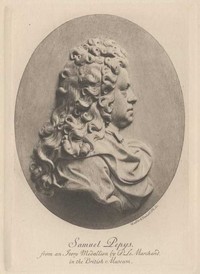
Read and listen together
 FrankensteinRead along