Read here

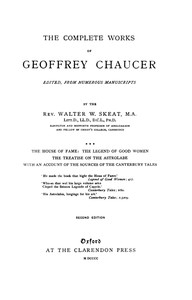
Chaucer's Works, Volume 3 — The House of Fame; The Legend of Good Women; The Treatise on the Astrolabe; The Sources of the Canterbury Tales

Geoffrey Chaucer · Public domain text

231,029 words · about 16 h 11 min to read

Cover of Chaucer's Works, Volume 3 — The House of Fame; The Legend of Good Women; The Treatise on the Astrolabe; The Sources of the Canterbury Tales

Text only · 7 illustrations omitted. Illustrated source.

About this edition

The text of Chaucer's Works, Volume 3 — The House of Fame; The Legend of Good Women; The Treatise on the Astrolabe; The Sources of the Canterbury Tales comes from Project Gutenberg e-text #45027. It is in English and public domain in the United States. Edited by Walter W. Skeat. RedLectern sets the text out for reading on screen; no words of the book are rewritten or summarized. More formats (EPUB, Kindle) · How RedLectern is built

This text-only edition leaves out 7 illustrations. See the illustrated edition at Project Gutenberg.

This book is long enough to be split into 8 parts, so each one loads quickly on its own.

About this book

Author
Geoffrey Chaucer (1342–1400)
Language
English
Subjects
English poetry › Middle English, 1100-1500
Length
231,029 words · about 16 h 11 min
Sections
16 reader sections · Table of contents
Contents (16)

The opening of Book I

God turne us every dreem to gode!
For hit is wonder, by the rode,
To my wit, what causeth swevenes
Either on morwes, or on evenes;
And why the effect folweth of somme, 5
And of somme hit shal never come;
Why that is an avisioun,
And this a revelacioun;
Why this a dreem, why that a sweven, And nat to every man liche even; 10
Why this a fantom, these oracles,
I noot; but who-so of these miracles
The causes knoweth bet than I,
Devyne he; for I certeinly
Ne can hem noght, ne never thinke 15
To besily my wit to swinke,
To knowe of hir signifiaunce
The gendres, neither the distaunce
Of tymes of hem, ne the causes
For-why this more than that cause is; 20
As if folkes complexiouns
Make hem dreme of reflexiouns;
Or elles thus, as other sayn,
For to greet feblenesse of brayn,
By abstinence, or by seeknesse, 25
Prison, stewe, or greet distresse;
Or elles by disordinaunce
Of naturel acustomaunce,
That som man is to curious
In studie, or melancolious, 30
Or thus, so inly ful of drede,
That no man may him bote bede;
Or elles, that devocioun …

Read on in Part 1 →